All Activity
- Past hour
-
I'd like to run the mainline kernel https://github.com/nickfox-taterli/avaota-a1-mainline-linux The board used to have a page and downloads here: https://armbian.com/boards/avaota-a1 but it's gone. Has support for this board been dropped?
-

Trying to boot Armbian on LinknLink iSG Box SE
rosic replied to Sancho's topic in Rockchip CPU Boxes
@Sancho this is amazing! If you have the test image ready I will be really glad to test it out. I have more than 1 iSG Box SE so I can test it on multiple devices. -
Hello , i have used now for some year armbian for this board, very many thanks for that; lately have updated to newer version Debian Trxiie and found that "htop" report a higher CPU usage after freshboot (around 50%) whereas previously it sat a 10% probably; now when evoking htop it gives (CPU offline for core 2-3-4) also nproc report "1" instead of "4"=? not sure if this an error ; noticed a similar report of nproc also with a build of volumio; thank you very much;
- Today
-
@savznkvo your rv2 boots from nvme? wich slot? what nvme model and vendor? wich kernel?
-

Armbian with preinstalled Home Assistant supervised
Igor replied to Igor's topic in Software, Applications, Userspace
Ask AI to fix problems at repo level: https://github.com/armbian/supervised-installer so we can all benefit. I don't have capacity to maintain this alone. -
 Sitrep / confirmed fix for “unhealthy: privileged” on Armbian Home Assistant Supervised After installing Home Assistant Supervised via Armbian on an Orange Pi 4 LTS, Supervisor was blocking add-on installation with: ‘AppManager.install’ blocked from execution, system is not healthy - privileged ha resolution info showed: unhealthy: privileged unsupported: os However Docker itself showed the Supervisor container was already privileged: docker inspect hassio_supervisor –format ‘{{.HostConfig.Privileged}}’ Output: true So the problem was not Docker missing –privileged. The Supervisor log also showed: Not privileged to run udev monitor! I checked the Supervisor AppArmor profile: sudo grep -n ‘deny network raw’ /var/lib/homeassistant/apparmor/hassio-supervisor It returned: 8: deny network raw, 70: deny network raw, Removing those deny network raw, lines from the AppArmor profile, reloading the profile, and restarting Supervisor fixed it. Commands used: sudo cp -a /var/lib/homeassistant/apparmor/hassio-supervisor /root/hassio-supervisor.apparmor.bak.$(date +%Y%m%d-%H%M%S) sudo sed -i ‘/^[[:space:]]deny network raw,[[:space:]]$/d’ /var/lib/homeassistant/apparmor/hassio-supervisor sudo apparmor_parser -r /var/lib/homeassistant/apparmor/hassio-supervisor sudo docker restart hassio_supervisor After restart: ha resolution info ha supervisor info Now shows: unhealthy: [] healthy: true unsupported: os supported: false I also tested the failing udev/netlink path directly: sudo docker exec hassio_supervisor python3 -c ‘import pyudev; pyudev.Monitor.from_netlink(pyudev.Context())’ It returned silently with no error. Conclusion: on this install, the “privileged” unhealthy state was caused by AppArmor blocking raw netlink access via deny network raw, in the hassio-supervisor profile. Docker was already privileged. Removing that AppArmor deny rule fixed Supervisor health and cleared the add-on install blocker. The remaining unsupported: os warning is expected for Armbian/Supervised and is separate from the privileged health failure.
 -

Armbian with preinstalled Home Assistant supervised
limorte replied to Igor's topic in Software, Applications, Userspace
I've got error unhealthy system - not privileged, asked claude opus to fix it. now everything works. Aked to make script to repeat fixes, here it is: https://github.com/limorte/armbian_trixie_v26.2.1_6.12.71_orangepi3lts-fix_ha_unprivileged_error/blob/main/fix-hassio-privileged.sh can't confirm it working - Yesterday
-
I extracted DTB/DTS from the Android FW (files attached). For whatever reason they are signed in the image as rk3568. No ideas why. 02_dtbdump_rockchip,rk3568-evb.dtb 02_dtbdump_rockchip,rk3568-evb.dtb.dts Attention: They are for Android! Linux might not boot with them!
-

Rupa X88 Pro 13 - RK3528 board with images
epost.deb replied to fedes_gl's topic in Rockchip CPU Boxes
I have compiled debian trixie image from the repository of @johlnx for Vontar DQ08 4G+64G and flashed it to eMMC, also adjusting the DTB for wifi GPIOs. Wifi works with the brcm4335 firmware (at least in the 2.4GHz band), usb3.0 works too. Bluetooth does not work and there are still many nasty error messages in the 'dmesg' output. -
Proprietary DDR and maskrom images from Rockchip Bare metall should provide DDR init replacement code, the only missing part in u-boot.
-
 I assume you are talking about local connection here, not from the internet, so it's ngiinx webserver you are talking about, not nginx-reverse-proxy? Can you at least ping the ip of the server? Syncing apps might not connect over http or https (or rather, they probably don't), which your browser does. Are you sure letsencrypt works properly and it's not just your browsers refusing to connect over https due to missing/miss-configured ssl certificates? Does forcing http connection at least give you some response? As for using wget to test: "wget --spider <url>" should get you some info. It should look something like this for correct setup using https: (enter url without http or https, I have redacted url and ip for obvious privacy reasons) $ wget --spider <your_url_here> Prepended http:// to '<redacted>' URL transformed to HTTPS due to an HSTS policy Spider mode enabled. Check if remote file exists. --2026-05-23 14:48:27-- https://<redacted> Loaded CA certificate '/etc/ssl/certs/ca-certificates.crt' Resolving <redacted> (<redacted>)... xxx.xxx.xxx.xxx Connecting to <redacted> (<redacted>)|xxx.xxx.xxx.xxx|:443... connected. HTTP request sent, awaiting response... 200 OK Length: 0 Remote file exists and could contain further links, but recursion is disabled -- not retrieving. But as eselarm said above, we need way more information to be able to help.
 -
also check this for kernel 7.0 https://github.com/Mr-DS-ML-85/rtl8188fu/tree/main
-
Wifi chip?
-
 I have modified the wifi driver for linux kernel 7.0 and backwards compatible https://github.com/Mr-DS-ML-85/rtl8188fu
 -
I am running bookworm on my Odroid HC4, upgraded from buster. USB stopped working, which I believe to be U-Boot related. So I am looking for a newer version of the U-Boot package "linux-u-boot-odroidhc4-current", which is at 26.2.1. I tried to change the apt sources to trixie and apt updated, but apt doesn't offer me a newer package. I am not so keen on compiling it myself, so is there a way of finding/downloading/installing a newer package...?
-
I bought this board because it has 2 lanes. So I changed the number of lanes in the dtb from 1 to 2. I need confirmation of an expert but my quick speed test with 2 lanes looks promising : gt@yy3568:~$ sudo hdparm -tT --direct /dev/nvme0n1p1 /dev/nvme0n1p1: Timing O_DIRECT cached reads: 1062 MB in 2.00 seconds = 530.34 MB/sec Timing O_DIRECT disk reads: 928 MB in 3.00 seconds = 308.97 MB/sec gt@yy3568:~$ sudo dmesg | grep lane [ 4.183004] phy phy-fe8c0000.phy.6: lane number 0, val 1 [ 4.183679] phy phy-fe8c0000.phy.6: lane number 1, val 2 pcie@fe280000 { compatible = "rockchip,rk3568-pcie"; #address-cells = <0x03>; #size-cells = <0x02>; bus-range = <0x20 0x2f>; clocks = <0x0f 0x8f 0x0f 0x90 0x0f 0x91 0x0f 0x92 0x0f 0x93>; clock-names = "aclk_mst\0aclk_slv\0aclk_dbi\0pclk\0aux"; device_type = "pci"; interrupts = <0x00 0xa5 0x04 0x00 0xa4 0x04 0x00 0xa3 0x04 0x00 0xa2 0x04 0x00 0xa1 0x04>; interrupt-names = "sys\0pmc\0msg\0legacy\0err"; #interrupt-cells = <0x01>; interrupt-map-mask = <0x00 0x00 0x00 0x07>; interrupt-map = <0x00 0x00 0x00 0x01 0xcb 0x00 0x00 0x00 0x00 0x02 0xcb 0x01 0x00 0x00 0x00 0x03 0xcb 0x02 0x00 0x00 0x00 0x04 0xcb 0x03>; linux,pci-domain = <0x02>; num-ib-windows = <0x06>; num-ob-windows = <0x02>; max-link-speed = <0x03>; msi-map = <0x2000 0x66 0x2000 0x1000>; num-lanes = <0x02>; phys = <0xca>; phy-names = "pcie-phy"; power-domains = <0x11 0x0f>; reg = <0x03 0xc0800000 0x00 0x400000 0x00 0xfe280000 0x00 0x10000 0x00 0xf0000000 0x00 0x100000>; ranges = <0x1000000 0x00 0xf0100000 0x00 0xf0100000 0x00 0x100000 0x2000000 0x00 0xf0200000 0x00 0xf0200000 0x00 0x1e00000 0x3000000 0x03 0x80000000 0x03 0x80000000 0x00 0x40000000>; reg-names = "dbi\0apb\0config"; resets = <0x0f 0xc1>; reset-names = "pipe"; status = "okay"; pinctrl-names = "default"; pinctrl-0 = <0xcc>; reset-gpios = <0x58 0x1e 0x00>; vpcie3v3-supply = <0xcd>; phandle = <0x271>; legacy-interrupt-controller { interrupt-controller; #address-cells = <0x00>; #interrupt-cells = <0x01>; interrupt-parent = <0x01>; interrupts = <0x00 0xa2 0x01>; phandle = <0xcb>; }; };
-
After much trouble with my old build environment I cloned Hqnicolas build repo. Now I can confirm that it seems to work. I made a quick speed comparison between the ssd and my external USB drive: gt@yy3568:~$ sudo hdparm -tT --direct /dev/sda /dev/sda: Timing O_DIRECT cached reads: 178 MB in 2.00 seconds = 88.89 MB/sec Timing O_DIRECT disk reads: 322 MB in 3.01 seconds = 106.88 MB/sec gt@yy3568:~$ sudo hdparm -tT --direct /dev/nvme0n1p1 /dev/nvme0n1p1: Timing O_DIRECT cached reads: 1160 MB in 2.00 seconds = 579.44 MB/sec Timing O_DIRECT disk reads: 690 MB in 3.00 seconds = 229.89 MB/sec Thank you very much to both @Arthur Gu and @Hqnicolas
-
 Here your debugging activity will need to start. There is an awful lot of things unknown, to others on this forum but more important, also to yourself. It could already be that your server (Armbian) has nothing to do with it, but that it is the info in your router (even caching stuff) that has refreshed, simply because you probably restarted, so something was not 'reset proof'. I have seen many of such things myself in my house/home networking and in conjunction with various ISP's (also mobile4G). Which made me use my own (open-source) router instance for example, so I can at least check all what is needed in such case as you have. But it might be simple, you can use wget (do 'man wget' first to see all options) to mimic browser behavior and that should already say something. If docker etc is involved, make sure you understand all (virtual) networking, it can get very complex. I haven't seen potentially disturbing things from Armbian 26.2.1, but I removed/blocked also several things, like no netplan.io, that at least works on Debian Trixie based installs. There have been lots of security related updates in Debian recently, so make sure you log and see changes to packages (edit listchanges.conf)
 -
 Hello, I’m facing yet another strange problem, and I am posting it here as well, because I think it could be OS related. Some details about my server: Armbian 26.2.1 trixie Nginx Nextcloud (latest) MariaDB Letsencrypt (updated 3 weeks ago) Until a few days ago, every browser on any of my devices could call the web gui of my server and Nextcloud presented its login page. Then, after the latest OS update, suddenly browsers tell my they can’t connect to the server, but every synching app on any of devices still work perfectly! And I can even access my files on the server by using FolderSync’s¹ internal file browser. It is just the browsers that can’t connect any more, no matter which browser, no matter which device! There is no error message in the appropriate log files, neither in the system log, nor in Nextcloud’s own log, and the message that the browsers present is simply some variation of “I can’t connect to server”. No specific reason, no error code. This is more than strange to me. I would get it if synching apps would have stopped working as well, but that is not the case. Does any one have an explanation for this mystery? If you need more information, just let my know! Many thanks in advance! (¹ Synching app on Android.)
 -
Perfect! It seems to be working well. ### lsblk: NAME FSTYPE SIZE MOUNTPOINT UUID mmcblk0 29.1G └─mmcblk0p1 ext4 28.8G / 53bf3b54-4988-4318-bf78-9ff6f0b851e5 mmcblk0boot0 4M mmcblk0boot1 4M zram1 ext4 50M /var/log 921565d0-0680-469e-ac03-555369d9549f zram2 0B nvme0n1 238.5G ├─nvme0n1p1 ntfs 529M 80DE33D8DE33C566 ├─nvme0n1p2 vfat 100M 5A34-53D4 ├─nvme0n1p3 16M └─nvme0n1p4 ntfs 237.8G 220438F50438CD93
-
Hello, I have a Tanix TX6-A TV box and I’ve tried many Armbian builds, including the ones from https://armbian.com/boards/tanix-tx6 and ophub. However, the onboard Wi-Fi does not work on any of them. Has anyone found an Armbian image that works properly with the Tanix TX6-A, including Wi-Fi support?
-

Rupa X88 Pro 13 - RK3528 board with images
fedes_gl replied to fedes_gl's topic in Rockchip CPU Boxes
I own the one of the 1st post and I managed to run Kodi desktop within Armbian. Just did few tests as I don't know how to set up remote control and many other things. HDMI works fine but no hardware acceleration for H265 videos (or at least doesn't work smooth enough as in the Android FW). LAN also works but is HW limited to 100mbps as stated by Joao -
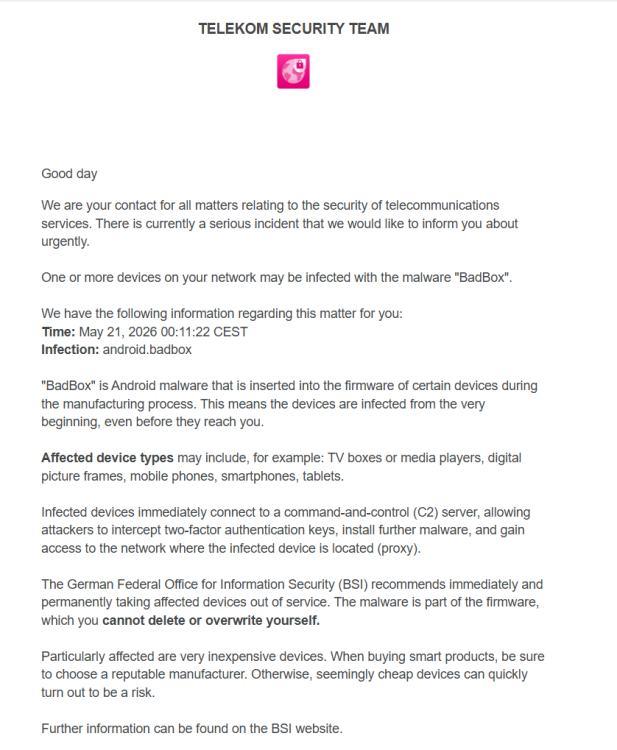
I know it was already written here in some of the messages that these devices are not secure. But now I got a message from Telekom that they detected a Chineese spyware connection: The timeframe is exactly when I have switched the device on with an Android on board.
- Last week
-
You'd better upgrade the kernel to 6.18 and keep Debian Bookworm, because Trixie has an mpv version which is not exactly friendly with hardware video decoding because some things are in the middle of a transition
-
OK, it looks like the BSP PCIe driver might have some issues related to power management. I’m not entirely sure of the root cause yet, but when I connected an NVMe drive, it got extremely hot and failed to initialize properly. The NVMe dmesg output suggested adding the following kernel parameters: nvme_core.default_ps_max_latency_us=0 pcie_aspm=off This resolved the NVMe issues on my side. I’ll try to dig deeper into the root cause, but @humanus please give it a try as well.