All Activity
- Past hour
-
 You have to allocate the I/O pins you want to use and how you want to use them yourself, can be done in armbianEnv.txt. A generic image cannot know what you want and what is connected to which I/O pins. GPIO is not like USB or PCIe that is can be automatically let its connected hardware enumerate. Also old Linux behavior w.r.t. GPIO is gone. You fundamentally need to open it, keep it operational with handle, in your code. Like you open a file when you want to read or write. Python might do that for you, but for C-code maybe look at lgio. So maybe tell first what you want to achieve, is it a temperature sensor maybe, or control a MOSFET or relay, etc.
 -
That would be a good start indeed.
-
 I installed Armbian_community_26.2.0-trunk.130_Orangepizero2w_trixie_current_6.12.63_minimal and tried to follow the instructions on gpiod · PyPI. GPIO are not enabled in device tree.
 - Today
-
Hi all! I have Armbian installed on a rock 4SE (Tagged as 4B as it uses the same image i believe) as the base for an OpenMediaVault. Yesterday i installed the latest version of Bookworm, as i am running OMV7 and that, as far as i can tell, does not work on Trixie. I am not ready to upgrade to Trixie/OMV8, as im not sure there is support for my Penta sata hat yet. My issue is that if i install the updates, either through OMV interface, or apt, the device does not boot after applying the updates. As far as i can tell from logs etc. something is either wrong with loading the kernel image on boot, or with the image itself. If i install Armbian, and then OMV, everything works just fine, i just have 132 pending updates. Including a kernel update that takes the version from 6.1.63, to 6.12.58. Have anyone had any similar issues, or any potential solutions? I can tell that it installed the updates by itself during the night, and is currently waiting for a reboot. And im a but scared to reboot it, since it might not boot correctly. Thanks in advance!
-
Yes, I am aware of this limitation.
-

mxq pro 4k 5g allwinner h313 can't sd card boot
Ducdanh Nguyen replied to Ducdanh Nguyen's topic in Allwinner CPU Boxes
Hey @Sergey Lepeshkin, i got the cable after 1-2 months now, i tried adb and all of them didn't regonize, only the middle port of the side, but i can't connect to it, it also beeps like theres a connection conflict, any solution? (There is no root on the board i tried using root detector and magisk), any help appreciated -

Need help with video decode acceleration on NanoPi R6S
Blind55 replied to Blind55's topic in NanoPi R6S/R6C
@eselarm Thank you very much for the details. I am currently working with the NanoPi R6S minimal image, with kernel 6.1 based on your feedback. I started out with the rolling release version, but that cannot run Jellyfin (because it is Forky). So I going back to the Trixie version and test this now. I will report back here whether the Jellyfin server works well with the transcoding of 4K movies (like the vendor FriendlyElec distribution does) and whether 4K movie playing can be smooth on it. -
I'm looking for an ARM board to self-host some stuff at home. My requirements is that the hardware is light enough that it doesn't requirement mechanical cooling, and can run yunohost [1] So my question at this stage is: how do I know about determining whether any given board requires its own cooling? Complete newbie here, I just want something small and silent. [1] https://doc.yunohost.org/en/admin/get_started/install_on/arm_board/
- Yesterday
-
Note that if you enable USB3, it disables PCIe. That's a hardware limitation of the a5e, I'm told...
-
Board that would fit though, the H4 PLUS from hardkernel, limited to 4 sata instead of 5. 120x120, but only 2 screws would fit I believe...
-
Update, this is also working .... extraargs=reboot=watchdog UPDATE: It stopped working after 3 successful reboots...
-
Ok update.. I used a USB Ethernet to update and now the local phy is showing as end0 and it works. I'm kind of doubting my story now. I know the initial login could not connect to the Ethernet. After I installed on the local emmc and upgraded via apt upgrade things work now. I think this is a non-issue.
-
The thing is that I need it on different boards .... Tried Armbian Trixie and Ubuntu based, same issue thus it might be uoot and/or kernel related. Thanks for your help though.
-
Some of the Board manufacturers SDK's broke due to a deleted repository; looks like someone's having a rough end to the year.
-
Dec 25th image for Cubie a5e is not a bootable image
eselarm replied to Meestor_X's topic in Allwinner sunxi
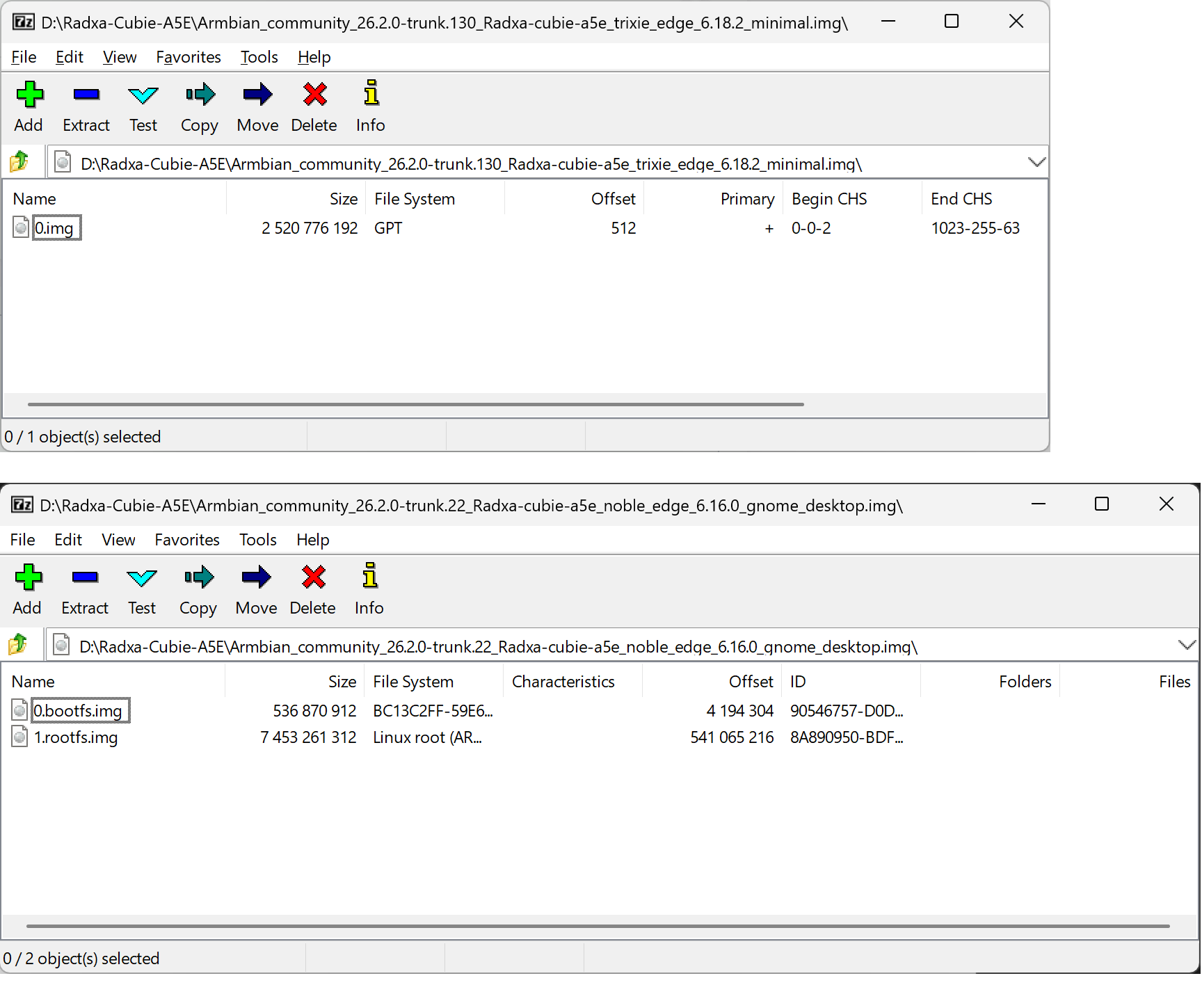
There is at least no primary GPT, all zeros from 0x200-0x20000 Fixed with: # gdisk Armbian_community_26.2.0-trunk.130_Radxa-cubie-a5e_trixie_edge_6.18.2_minimal.img GPT fdisk (gdisk) version 1.0.10 Caution: invalid main GPT header, but valid backup; regenerating main header from backup! Warning: Invalid CRC on main header data; loaded backup partition table. Warning! Main and backup partition tables differ! Use the 'c' and 'e' options on the recovery & transformation menu to examine the two tables. Warning! Main partition table CRC mismatch! Loaded backup partition table instead of main partition table! Warning! One or more CRCs don't match. You should repair the disk! Main header: ERROR Backup header: OK Main partition table: ERROR Backup partition table: OK Partition table scan: MBR: protective BSD: not present APM: not present GPT: damaged **************************************************************************** Caution: Found protective or hybrid MBR and corrupt GPT. Using GPT, but disk verification and recovery are STRONGLY recommended. **************************************************************************** Command (? for help): w Final checks complete. About to write GPT data. THIS WILL OVERWRITE EXISTING PARTITIONS!! Do you want to proceed? (Y/N): y OK; writing new GUID partition table (GPT) to Armbian_community_26.2.0-trunk.130_Radxa-cubie-a5e_trixie_edge_6.18.2_minimal.img. Warning: The kernel is still using the old partition table. The new table will be used at the next reboot or after you run partprobe(8) or kpartx(8) The operation has completed successfully. -
OK, I have the following in my test NanoPi-NEO (using 6.18 kernel): U-Boot SPL 2024.01-armbian-2024.01-S866c-P7738-Ha5c2-V2b78-Bb703-R448a (Mar 09 2025 - 03:54:42 +0000) Same base, but it is older and anyway different hardware, although H3 SoC. I have no more ideas why you need that extra kernel cmdline statement. I think I have seen it as well for another board/SoC, but does not ring a bell.
-

Dec 25th image for Cubie a5e is not a bootable image
ariel1 replied to Meestor_X's topic in Allwinner sunxi
Can confirm that version trunk 130 is not bootable. Tried with balenaEtcher and Win32DiskImager. Looks like trunk 130 is a GPT image unlike the older ones.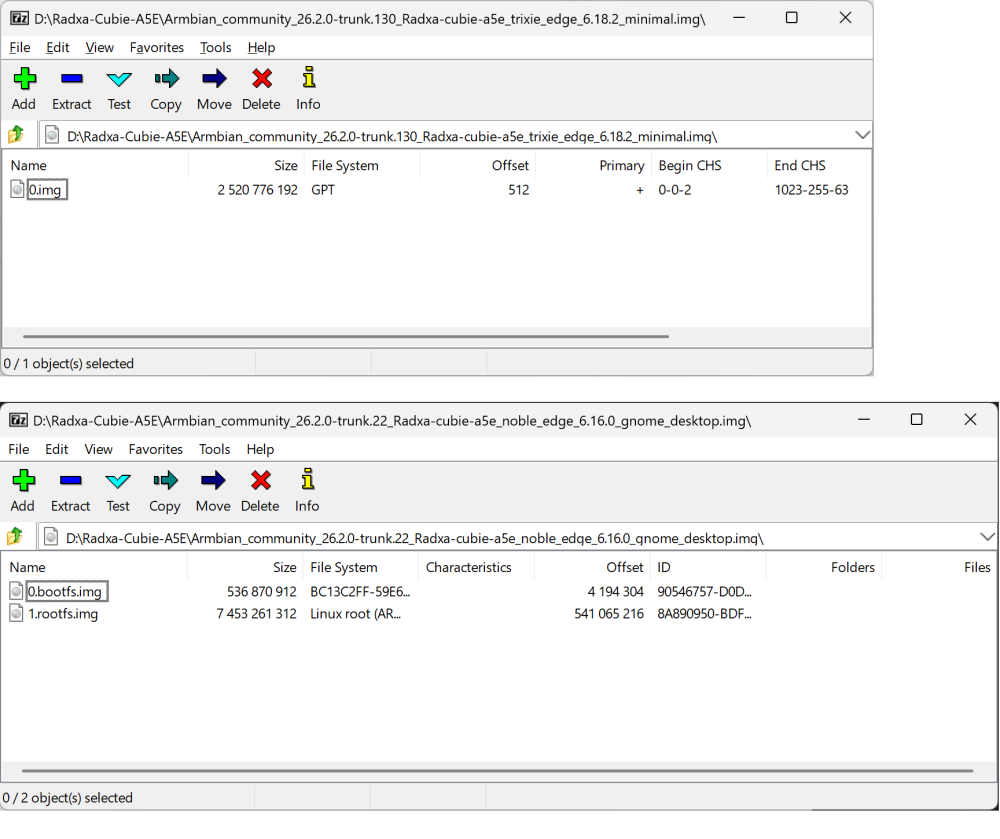
-
Didn't warn ffmpeg from a guts feel years ago that they will issue a takedown if no action is taken? So I'm not surprised. Kind of.
-

Dec 25th image for Cubie a5e is not a bootable image
Werner replied to Meestor_X's topic in Allwinner sunxi
I don't have this hardware. However the last merged PR messing with code for this board/SoC was tested by Igor and he stated it boots just fine. -
Interesting question. The dxf says the part in question is labeled ED1 besides CP18 and CP14. I found both CP18 and 14 in the schematics but ED1 not. Either mislabeled or I didn't catch it. https://x.na4.eu/KOTu3/quzevoji80.jpg OrangePi-Schematic of ZERO3.pdf
-
Here is the output: U-Boot SPL 2024.01_armbian-2024.01-S866c-P6b16-Ha5c2-V7d7d-Bbf55-R448a (Dec 22 2025 - 03:39:51 +0000) Note that prior to this I tried to update uboot through armbian-install, it did not change anything to my reboot issue.
-

Dec 25th image for Cubie a5e is not a bootable image
Meestor_X replied to Meestor_X's topic in Allwinner sunxi
But... every other image I've ever created with Balena has been fine? Dozens of armbian images including trunk 100... Trunk 130 image is working fine for you on the a5e? -
Dec 25th image for Cubie a5e is not a bootable image
Werner replied to Meestor_X's topic in Allwinner sunxi
Balenaetcher is known to cause trouble. Use USBimager or Armbian imager https://docs.armbian.com/User-Guide_Getting-Started/ -
I was working with OpenHD when it was taken down by GitHub. There's something we should be concerned about here in the rockchip section of armbian? Original Post: https://github.com/github/dmca/blob/master/2025/12/2025-12-18-ffmpeg.md Identify only the specific file URLs within the repository that is infringing: https://github.com/rockchip-linux/mpp/blob/develop/mpp/codec/dec/av1/av1d_codec.h https://github.com/rockchip-linux/mpp/blob/develop/mpp/codec/dec/av1/av1d_cbs.c https://github.com/rockchip-linux/mpp/blob/develop/mpp/codec/dec/av1/av1d_cbs.h https://github.com/rockchip-linux/mpp/blob/develop/mpp/codec/dec/av1/av1d_parser2_syntax.c https://github.com/rockchip-linux/mpp/blob/develop/mpp/codec/dec/h265/h265d_codec.h https://github.com/rockchip-linux/mpp/blob/develop/mpp/codec/dec/h265/h265d_parser.c https://github.com/rockchip-linux/mpp/blob/develop/mpp/codec/dec/h265/h265d_ps.c https://github.com/rockchip-linux/mpp/blob/develop/mpp/codec/dec/vp9/vp9d_codec.h https://github.com/rockchip-linux/mpp/blob/develop/mpp/codec/dec/vp9/vp9d_parser.c https://github.com/rockchip-linux/mpp/blob/develop/mpp/codec/dec/vp9/vp9data.h https://github.com/rockchip-linux/mpp/blob/develop/mpp/codec/dec/vp9/vpx_rac.c https://github.com/rockchip-linux/mpp/blob/develop/mpp/codec/dec/vp9/vpx_rac.h
-
I believe I'm having a similar issue. I'm running the Renegade Rockchip Libre Computer ROC-RK3328-CC-V1.3-8 and I've tried 6.12.32-current-rockchip64 as Debian IOT Minimal and as the Ubuntu Server versions from https://www.armbian.com/renegade/. Unfortunately the onboard ethernet phy is not working but I can use a USB ethernet just fine. I'm not super sure where to start troubleshooting other than a binary search for the version that broke things. If more info is needed from my setup I'm happy to post, let me know.