defcom5-rockchip
Members
-
Joined
-
Last visited
Everything posted by defcom5-rockchip
-
Prerequisites fixed, Rockchip moves closer. Bug 2078820 depends on Bug 2084900, which changed state. What Removed Added Status NEW RESOLVED Resolution --- FIXED Referenced Bugs: [Bug 2084900] [Linux] Merge RenderWaylandTextureHost / AsRenderDMABUFTextureHost to RenderLinuxTextureHost Additional info from Claude: Good news, but this is the groundwork, not our fix yet. What landed: Stránský's bug 2084900 went into Firefox's main code on 2026-11-13. It took four tries: it was backed out once for breaking the build and twice for failing a 10-bit colour test. A crash it caused was fixed the next day. It ships in Firefox 162: beta from 11-23, release on 12-08. What it means for our bug: on 11-07 he said he was waiting for this. It merges two parts of Firefox's Linux code that pass video frames to the screen into one. The part that would fix our bug comes next; he calls it "dmabuf format conversion", and it hasn't been posted yet. Our bug has had no new comments since 11-07, and none of the six bugs he has filed since then is linked to it. It's still open, with his own reminder flag on it, and it's listed on both of Mozilla's Linux video tracking bugs. We don't need to post anything; your offer to test (comment 15) already stands. Checked against what we ship: Our Mali library: it hooks the step where Firefox loads each part of a video frame. This change didn't touch that code, and today's version still makes the same calls the library catches. Compositor hand-off: the part that did change sends video straight to the desktop compositor. It only runs with a Firefox setting our image locks off. GPU process: 162 also adds Firefox's GPU process on Wayland, but it's switched off by default on Linux. Our v3 patch: it still applies cleanly to today's Firefox code, if he wants it.
-
https://github.com/defcom5-rockchip/pi-desktop/releases/tag/v6.5.0 Plaid Pi Plus 6.5: the Orange Pi 5 Plus as a desktop computer. KDE Plasma 6.6 on Mesa's open Panthor GPU driver, Ubuntu 26.04 packages, Armbian's Rockchip vendor kernel merged with upstream stable Linux 6.1.191 (tag pi-desktop-6.5). One image for the Orange Pi 5 Plus; the Orange Pi 5B and 5 stay on 6.0 (GNOME) until their 6.5 image has been through the same tests. Checked on an Orange Pi 5 Plus on 2026-11-17: 150 of 150 first-boot checks on the board (151 of 151 after Pro Updates, the first-click apps and a reboot), and 115 of 115 checks of the image file. Since 6.0: An Orange Pi 5 Plus image. 4K at 120 Hz on its HDMI 2.1 output (kernel patch 0020 gives the 5 Plus the display clock tree the 5B got in 4.0), hardware video in mpv and the browsers, Wi-Fi and Bluetooth audio on an Intel AX210 card. Tested on one board; what was not tested (eMMC, the Broadcom Wi-Fi module) is in KNOWN-ISSUES HW-2. KDE Plasma 6.6.6 on the open GPU driver (Mesa Panthor), with the Plaid look, Dolphin's Network Drive and disc menus, and the apps as first-click installs like the GNOME image. DVDs and Blu-rays copied to folders play from the desktop. Right-click the folder in Dolphin ▸ Play DVD or Blu-ray, or double-click its VIDEO_TS.IFO: mpv opens the folder in place (0.42 adds ISO images and the disc menus), starts the longest title and switches its deinterlacer on. In a headless probe from the build PC, 53 of the 55 DVD folders on the maintainer's NAS opened as discs (the two that did not are incomplete copies); Streets of Fire was watched on the 5 Plus. A disc in a USB drive plays with its menu. Cinemosk's Play the disc in the drive starts a DVD in the disc's own menu (mpv 0.42). Bought DVDs need libdvdcss, which Plaid Pi cannot include: Cinemosk offers to build it on the computer. On the 5 Plus it took 1 min 50 s from Cinemosk's Disc support and 51 s from the first-time offer (one run each; it includes downloads, so it varies), and a bought DVD then played from the drive with its menu. Blu-ray discs go through the same button, and Disc support adds Java 21 for Blu-ray menus written in Java; no Blu-ray disc was tested. Bought Blu-rays stay encrypted. One Wi-Fi interface per card. Rockchip's kernel gave every Wi-Fi card whose driver uses mac80211 a second, unusable interface; on the 5 Plus with an Intel AX210 the name of the working one changed between boots and a saved network stopped reconnecting. Kernel patch 0028 removes it, and the fix is sent to Armbian (linux-rockchip #621). Cinemosk, a picture-settings window for films: Smooth, Balanced or Sharp enlargement with the GPU cost of each measured on the board shown next to the choice; banding clean-up, screen fill and even 24 fps motion for DVDs; per-folder overrides (Alt+C in mpv) and a meter (Alt+M). Films start on Balanced: at 4K on the 5 Plus it is sharper than Smooth for the same GPU load (21 %); Sharp costs 28 %. mpv 0.42, libplacebo 7.387, libdvdread 7.1.1, GStreamer 1.28.9, rebuilt from Ubuntu's and Debian's packaging (the Mali zero-copy patches, DVD-Audio, the native PipeWire output; GStreamer's FLAC seek and decodebin3 fixes and two security follow-ups Ubuntu 26.04 lacks). The frame-pacing findings from the 5 Plus tests are in the defaults (ao=pipewire,alsa and the KDE profile in /etc/mpv/mpv.conf). Kernel 6.1.191 with the stable fixes since 6.1.189, the ext4 NULL dereference its mballoc backport introduced fixed on top (patch 0027; the same fix is queued upstream for 6.1.193), an upstream Bluetooth MGMT use-after-free fix with its two follow-ups, and the vendor-driver adaptations the merge needed (the Broadcom Wi-Fi one is sent to Armbian as linux-rockchip #620). The edition's name everywhere, including KDE's About this System and the system partition (plaid_root, was Armbian's armbi_root), and the console login banner kept after updates. Panel icons for VSCodium and Audacity: both apps renamed their menu entries (VSCodium 1.143, XtraDeb's Audacity 4), so the panel's icons pointed at nothing; they use the new names now. On 6.0 the dock still uses the old names (not tried on a 6.0 board): if the VSCodium or Audacity icon disappears or does nothing, after installing VSCodium or after an update brings XtraDeb's Audacity 4, add the app to the dock again from the app grid. Two fixes from the test images: Armbian's November firmware package ships the AP6275P driver's configuration-file link as a 17-byte text file (the recipe restores the link; checked in the image, not on the air, as the test board has no AP6275P), and Armbian's base-files re-created the login-screen wordmark links on an update (now diverted; DSK-2 has the one-time fix for 6.0). This is kernel held so no easy update path FYI And we script the Firefox Install to use hardware which they are waiting to fix with Nvidia bug.
-
-
-
@igorpaunovic The HDMI finding, in full. What the series does. Cristian Ciocaltea's 15 patches teach the RK3588's HDMI 2.1 block (the Synopsys DW HDMI QP) to output YUV422 at 10 bits and YUV420 at 8 or 10 bits, instead of RGB only. That matters for 4K at 120 Hz over HDMI 2.0-class links and for HDR sinks that want YUV. Patches 1 to 10 are VOP2 fixes and clock plumbing, 13 and 14 add the formats, 15 is the device tree. Heiko took all of it into drm-misc-next on 2026-11-06, so it is headed for the next merge window. Where the pixels come from. The VOP2 is the display controller that feeds the HDMI block. Its video port has a dither stage, and one bit in the port's control register, called pre-dither-down, converts the 10-bit pipeline to 8 bits with Allegro dithering before the data leaves the VOP. The TRM entry for that bit reads "10bit to 8bit (allegro)". Pre-dither exists so that an 8-bit output does not get a hard truncation. The HDMI block then takes what the VOP hands it. If the VOP already dithered to 8 bits, a 10-bit link carries 8-bit content padded to 10. The bug. Mainline's dither setup has two parts. The switch on the bus format enables pre-dither for the 8-bit YUV formats, which is right. But after the switch it also enables pre-dither for any output mode other than the plain RGB mode, unconditionally. That line predates the series. Before the series it was harmless, because every non-RGB mode the driver could produce was 8-bit anyway. The series adds two 10-bit YUV bus formats and routes them through the same function, and that line fires for them too. So selecting the new "10-bit YUV422" or "10-bit YUV420" modes gets you 8-bit dithered content on a 10-bit link. Why we are confident without hardware. Rockchip's own driver, the one in our vendor kernel, handles exactly this: its version of the same function has an explicit case for the 10-bit formats (YUYV10, YUV10, UYYVYY10 and RGB101010) that turns pre-dither off, and a second rule that turns it off for all YUV output on ports without the newer frame-rate-conversion block. Mainline has neither. The register semantics come from the TRM, the vendor behaviour from Rockchip, and the mainline code is what we read in drm-misc-next this morning. What we cannot do here is prove it on a panel: that needs a 10-bit sink and either a capture card or a gradient test pattern on a display that shows banding, and a mainline kernel on the test board, which is not our daily lane. Why nobody caught it. The series was reviewed for apply-cleanliness, clocks and the HDMI side. The reviewers tested that the modes negotiate and display, which they will. 8-bit dithered 10-bit looks fine to the eye on most content. A bot reviewer flagged other things in v5 but not this. The dither line is not in the series' diff, so a diff-only review never sees it. What a report would say. A short mail to the v6 thread on linux-rockchip and dri-devel, to Cristian and Heiko: the line, the TRM bit description, the vendor driver's handling, and the suggested fix, which is to skip pre-dither when the output bit depth is above 8 or when the bus format is one of the 10-bit ones. It is a one-liner to fix and a follow-up patch rather than a revert. I would post it as a finding rather than a patch, stated plainly as a code-and-TRM reading with no hardware proof, since Cristian has the hardware to confirm it and write the fix. If you want to run with it yourself, go ahead; I am short on time right now (new job, working nights). For Your Consideration defcom5-rockchip
-
Two releases are out for RK3588 / RK3588S boards running a Rockchip vendor (BSP) kernel. Not for mainline kernels. rockchip-vaapi 4.0.0 "Pepper Pro" is the VA-API driver that lets Firefox, mpv, ffmpeg and VA-API builds of Chromium decode H.264, HEVC, VP9 and AV1 (8- and 10-bit) on the board's video engine, through Rockchip's MPP library. This release fixes H.264 and HEVC streams the hardware used to get wrong: custom quantisation tables (common in Blu-ray and broadcast encodes), interlaced H.264, some multi-slice and High 10 H.264, and HEVC streams with less common header layouts. Standard conformance streams decoded bit-exact on the hardware: H.264 74 → 111 of 135, H.264 High profiles 6 → 48 of 48, HEVC 17 → 141 of 147. Interlaced H.264 now comes out weaved; deinterlacing is up to the player (mpv --deinterlace=yes, in software). VP9 and AV1 are unchanged, except that an AV1 stream that grows mid-stream no longer crashes ffmpeg. MPP +pd35 is an unofficial build of Rockchip's MPP with three fixes for RK3588: AV1 film grain applied by the hardware (new), VP9 on both decoder cores without the errors that started after about 65,000 frames (18 minutes at 60 fps), and 4K60 AV1 in Firefox keeping up (each picture decoded once, not twice). Where it works SoC: RK3588 and RK3588S. RK3576 untested (it has AV1 hardware, but this driver's AV1 path has only run on RK3588). RK356x untested, no AV1. Kernel: vendor kernel with MPP; check with: ls /dev/mpp_service. Tested on Armbian's vendor branch (6.1.189-vendor-rk35xx); earlier releases also on ubuntu-rockchip 6.1.0-1027. Armbian current/edge (mainline) have no MPP, so the driver does not apply there. Boards: Orange Pi 5B (all numbers above). Orange Pi 5 Plus confirmed by a forum tester on earlier releases. Other RK3588/RK3588S boards on a vendor kernel should work; reports welcome. Distro: the driver package is built and tested on Ubuntu 26.04 and should install on 24.04 (not tested yet). It needs glibc 2.38 or newer, so not Ubuntu 22.04 or Debian 12; Debian 13 untested. It also needs librockchip-mpp1 and librga2, which Ubuntu, Debian and Armbian's repository do not carry. On 24.04 they come from the rockchip-multimedia PPA (ppa:jjriek/rockchip-multimedia; Ubuntu-Rockchip images already have it, and adding it also replaces ffmpeg, GStreamer and mpv with its builds). Check with: apt-cache policy librockchip-mpp1 librga2 GPU: works with Arm's Mali driver, panfork Mesa, or Panthor. 4K needs more CMA memory: on Armbian add extraargs=cma=512M to /boot/armbianEnv.txt and reboot (check: grep CmaTotal /proc/meminfo). Install Driver: https://github.com/defcom5-rockchip/rockchip-vaapi/releases/tag/v4.0.0 then: sudo apt install ./rockchip-vaapi_4.0.0-1_arm64.deb (add --allow-change-held-packages if your image holds it). The package sets the VA-API environment for every user; log out and back in. MPP: https://github.com/defcom5-rockchip/mpp/releases/tag/pd35 (files for 24.04 and 26.04, and how to go back). Optional if you already have MPP from the PPA, but the PPA build loses VP9 frames in long sessions, and 4K60 AV1 in Firefox needs this one. Firefox needs three about:config settings, four for HEVC: https://github.com/defcom5-rockchip/rockchip-vaapi/blob/main/INSTALL.md . Chromium builds that decode through libv4l-rkmpp (some vendor images) do not use this driver; chrome://gpu shows which path you have. Problems or reports from other boards: https://github.com/defcom5-rockchip/rockchip-vaapi/issues with board, uname -a, distro, apt-cache policy librockchip-mpp1, and the codec and resolution (full list in KNOWN-ISSUES.md, "Reporting"). The code was written and debugged with an AI assistant (Claude) under my direction, credited per commit. Every number above comes from runs on real hardware, kept in the repository's evidence/2026-10-25-* folders.
-
As a side note when I switched back to Firefox from Chrome The picture quality seemed much better.. No Test done just an observation. added Info: The test clips are ready on .214 in ~/Videos/levels/: levels-8-av1.mp4 and levels-10-av1.mp4, with copies on the NAS. Each is 30 seconds of 1080p AV1 with two rows of patches: Top row: a below-black patch (8), black (16), then dark steps from 17 to 40. Bottom row: light steps from 200 up, white (235), and above-white patches. I decoded both clips and checked every patch: all 26 hold their exact values at both bit depths. That check caught an ffmpeg quirk on the first try that had shifted and clipped the levels; the fix was to tag the colour information at the input, not the output. Tomorrow's test: play each clip in Chrome forced onto software decoding (the same drawing path Netflix uses) and in Firefox, and count how many dark steps you can tell apart. FFmpeg 9: I read the official changelog for 9.0 through 9.0.2. There's nothing that would change black levels or our picture problem. The colour items are AMD's AMF converter getting HDR, Vulkan support in the scaler, and a set of scaler crash and overflow fixes. More to the point, Netflix doesn't go through FFmpeg in either browser: Google's DRM module decodes the video itself. So FFmpeg 9 can't be the fix here. It does matter for mpv and Firefox's non-DRM playback, so it's worth a separate look when Ubuntu packages it.
-
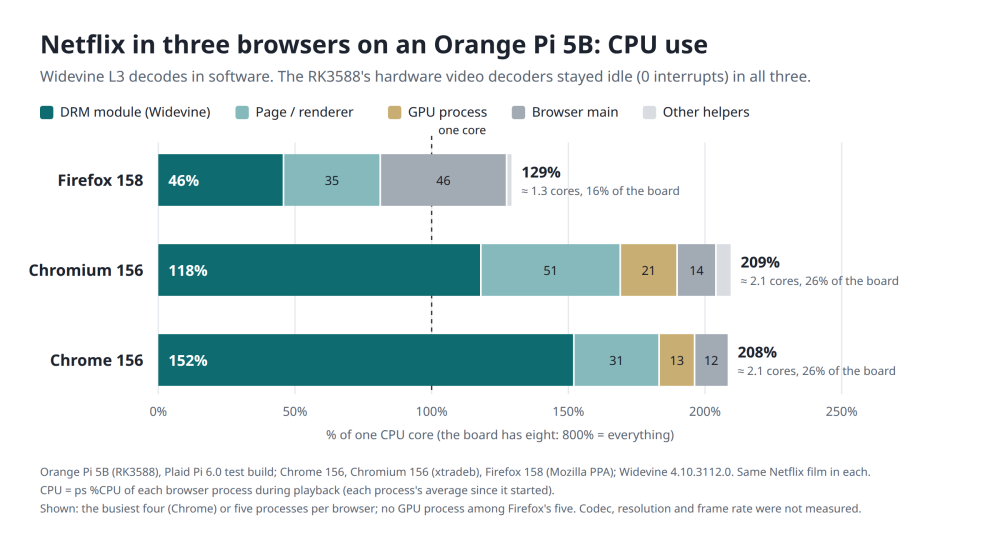
Netflix plays in all three browsers on the Orange Pi 5B: Chrome 156, Chromium 156 (xtradeb) and Firefox 158 (Mozilla Team PPA, the deb; I haven't tried the snap, which is confined and probably can't read /opt/google), all using Chrome's Widevine 4.10.3112.0. Tested on a Plaid Pi 6.0 test build rather than the release image I mentioned. Two corrections to my first post: step 3 (Firefox) and step 4 (the check). Step 3: the folder layout I gave is wrong. With it, Firefox's Widevine plugin crashes as soon as a site starts using it: Netflix shows F7701-1003, Firefox says the Widevine plugin crashed, and the crash core points at Firefox's "Plugin file does not exist" check. Firefox takes the module's file name from the parent of the MOZ_GMP_PATH folder: a parent named gmp-widevinecdm makes it load libwidevinecdm.so (in my tests, a parent named gmp-foo made it look for libfoo.so). The inner folder's name doesn't matter. mkdir -p ~/.local/share/widevine-from-chrome/gmp-widevinecdm/system-installed cd ~/.local/share/widevine-from-chrome/gmp-widevinecdm/system-installed ln -sfn /opt/google/chrome/WidevineCdm/_platform_specific/linux_arm64/libwidevinecdm.so . ln -sfn /opt/google/chrome/WidevineCdm/manifest.json . MOZ_GMP_PATH=$HOME/.local/share/widevine-from-chrome/gmp-widevinecdm/system-installed firefox Quit Firefox completely before the last line (Ctrl+Q, not just closing the window): a running Firefox only opens a new window and never sees the variable. The about:config prefs from step 3 stay as they were. If you made the variable permanent (a launcher script or ~/.config/environment.d/), change the path there too; environment.d needs a log out and back in. The two old links directly in ~/.local/share/widevine-from-chrome can be deleted. Step 4: in Firefox, the console check I posted only shows the module's manifest was found. It answered ok with the layout from my first post, while the module itself couldn't load. This version loads the module and asks it to create a license request; the snippet sends nothing to any server. Open the developer console (F12) on any https page (the Bitmovin demo page will do) and paste it. In a fresh profile the console first asks you to type "allow pasting". (async()=>{const id=[0xed,0xef,0x8b,0xa9,0x79,0xd6,0x4a,0xce,0xa3,0xc8,0x27,0xdc,0xd5,0x1d,0x21,0xed],d=[0x12,0x10,...Array(16).fill(1)];const pssh=new Uint8Array([0,0,0,32+d.length,0x70,0x73,0x73,0x68,0,0,0,0,...id,0,0,0,d.length,...d]);try{const a=await navigator.requestMediaKeySystemAccess("com.widevine.alpha",[{initDataTypes:["cenc"],videoCapabilities:[{contentType:'video/mp4; codecs="avc1.42E01E"',robustness:"SW_SECURE_DECODE"}]}]);const s=(await a.createMediaKeys()).createSession();s.onmessage=e=>console.log("Widevine works: license request of "+e.message.byteLength+" bytes");await s.generateRequest("cenc",pssh)}catch(e){console.log("Widevine failed: "+e.name+" "+e.message)}})() Working: "Widevine works: license request of 1701 bytes" (the size may differ). Chromium without the hint file: "Widevine failed: NotSupportedError Unsupported keySystem or supportedConfigurations." Firefox with my first post's layout: "Widevine failed: NS_ERROR_FAILURE". Some other wrong layouts print nothing at all, so no answer after twenty seconds is also a failure. Checked in fresh headless profiles of all three browsers, and the corrected Firefox commands above were run as written. What playback costs: decoding is all software. The board's hardware video decoders stayed idle (no interrupts in ten-second samples during playback in each browser). The DRM process is the biggest single load in Chromium and Chrome; in Firefox the main process uses as much. ps showed the DRM process at about 46% of one core in Firefox, 118% in Chromium and 152% in Chrome; I didn't check which codec Netflix sent each one. The heaviest is about 1.5 cores, under a fifth of the RK3588's eight (four of which are the small A55s). I didn't check the resolution either; at Widevine L3, services generally cap Linux browsers at SD or 720p. A correction to my first post's last paragraph: I said the image's first-boot check verifies both pointers. It checks that the pieces are in place; it doesn't load the module, which is how the broken Firefox layout got past it. Plaid Pi 6.0 (still in test) builds the corrected layout in its Firefox launcher, and its first-boot check now confirms the launcher uses it. An LLM assistant (Claude) found the cause from Firefox's crash core, wrote and ran the headless console tests and the gmp-foo test, took the CPU and interrupt measurements, and drafted this post. I did the Netflix playback tests on the board.
-
Short version: Google's arm64 Linux Chrome package ships Widevine, the DRM module streaming services use. Chromium and Firefox on arm64 don't ship it (Chromium is built with Widevine support but without the module; Mozilla ships no Widevine for aarch64 Linux at all), but both can use Chrome's copy if you tell them where it is. Nothing gets copied, so Google's licence on the module isn't an issue: it stays Google's install, and the pointer is your own configuration. Tested on an Orange Pi 5B (Armbian's rk-6.1 vendor kernel, Ubuntu 26.04 userspace) with Chrome 156, Chromium 156 (the xtradeb build) and Firefox 158 (Mozilla Team PPA). None of this is board-specific; it should work on any arm64 desktop where the arm64 Chrome .deb installs. 1. Install Google Chrome https://dl.google.com/linux/direct/google-chrome-stable_current_arm64.deb and sudo apt install ./google-chrome-stable_current_arm64.deb The module lands in /opt/google/chrome/WidevineCdm (libwidevinecdm.so under _platform_specific/linux_arm64, plus manifest.json). Chrome plays protected streams straight away. 2. Chromium Chromium looks for a one-line "hint" file in its profile, the same file Chrome writes in its own profile. Create it with the version from Chrome's manifest: mkdir -p ~/.config/chromium/WidevineCdm V=$(sed -n 's/.*"version"[[:space:]]*:[[:space:]]*"\([0-9.]*\)".*/\1/p' /opt/google/chrome/WidevineCdm/manifest.json) printf '{"LastBundledVersion":"%s","Path":"/opt/google/chrome/WidevineCdm"}' "$V" > ~/.config/chromium/WidevineCdm/latest-component-updated-widevine-cdm Restart Chromium. Two things that do NOT work, so you don't waste time on them: a copy of the module in ~/.local/lib/libwidevinecdm.so, and a copy of Chrome's WidevineCdm folder into the Chromium profile. Only the hint file worked here. 3. Firefox Firefox loads Widevine from folders named in the MOZ_GMP_PATH environment variable. Make a folder with two symlinks to Chrome's files, then start Firefox with the variable set: mkdir -p ~/.local/share/widevine-from-chrome ln -sfn /opt/google/chrome/WidevineCdm/_platform_specific/linux_arm64/libwidevinecdm.so ~/.local/share/widevine-from-chrome/ ln -sfn /opt/google/chrome/WidevineCdm/manifest.json ~/.local/share/widevine-from-chrome/ MOZ_GMP_PATH=$HOME/.local/share/widevine-from-chrome firefox In about:config set media.gmp-widevinecdm.visible = true, media.gmp-widevinecdm.enabled = true and media.eme.enabled = true (the first is false by default on platforms Mozilla doesn't ship Widevine for, which hides the whole thing). media.gmp-widevinecdm.autoupdate = false keeps the plugin updater from looking for a copy Mozilla doesn't have. To make it permanent, put the variable in a launcher script or in ~/.config/environment.d/. 4. Checking it Before trying a service, this page tells you whether the module loaded: open https://bitmovin.com/demos/drm (Widevine test streams) or ask the browser directly from the console: navigator.requestMediaKeySystemAccess("com.widevine.alpha",[{initDataTypes:["cenc"],videoCapabilities:[{contentType:'video/mp4; codecs="avc1.42E01E"'}]}]).then(a=>console.log("ok",a.getConfiguration().videoCapabilities[0].robustness)).catch(e=>console.log("no",e.name)) Here all three browsers answer ok with robustness SW_SECURE_DECODE, which means the module loaded. That level is Widevine L3, so services serve SD or 720p on Linux; that is Widevine's rule, not the hardware's. I'll add playback results with real services once I've run them on the release image. EVIDENCE I've automated both pointers in Plaid Pi, my GNOME 50 image for the Orange Pi 5 and 5B (Ubuntu 26.04 packages, built with the Armbian framework): a /etc/chromium.d snippet writes Chromium's hint at every start, the Firefox launcher keeps the symlink folder and sets MOZ_GMP_PATH, and the image's first-boot check verifies both. The current release is 5.5; the version with these pieces is 6.0, in test now. Recipe: https://github.com/defcom5-rockchip/pi-desktop-recipe (the two files land there with the 6.0 release). Releases: https://github.com/defcom5-rockchip/pi-desktop/releases. An LLM assistant (Claude) did the probing with me; I ran it on the hardware.
-
More Testing On The new Patch.... Firefox was glitching but now the numbers have changed. Confirmed the AV1 decode is now working off a healthy ~35MB read-ahead burst instead of the previous bare 9 Mbit/s trickle, giving it the buffer cushion it was missing. I'm setting a watcher for the glitch pattern (decoder stalls/resumes) and will report back with a summary in about 10 minutes.
-
I dropped a 4k 60fps VP9 on Firefox last night and ran into glitches over the NAS... Claude said Firefox handles Network differently than MPV... They are Fashioning it to work... updates to come.
-
Tests are 4k@60FPS
-
Update and numbers.... They had me change the methodology of my patch and the numbers look great. On these clips the default task count gives +44 % / +29 % (10-bit / 8-bit) over the one-task reference; with hal_task_count = 2 on the earlier clips it was +26 % / +25 % — different clips, so only indicative. "Thanks for confirming on your side. When this is merged, it will go through our internal Gerrit review, and your commit will keep your authorship and Signed-off-by."
-
update to Firefox... Submitted 2nd patch with 4 changes. New email added a person... Claude > I've logged it; there's nothing to do. "pasik" is almost certainly Pasi Kärkkäinen, going by the address pasik@iki.fi. He's a long-time Linux and Xen community member who follows Linux hardware-video bugs in Firefox. I don't know of him being a Mozilla maintainer, so I'd read this as an interested watcher rather than a reviewer. He CC'd himself on the 15th, the same day as Robert Mader, which was the day the triager said the approach was right — so the bug got noticed then. Current state of the bug: Stránský still holds the needinfo ("will look at it"), with Mader and Pasi watching. I'll suggest a nudge only if it's still quiet in about a week.
-
For your consideration: <Claude> On Jellyfin's code: they don't deal with the issue at all. That's why they hit it. jellyfin-ffmpeg builds its own private copy of MPP, pinned in builder/scripts.d/50-rkmpp.sh: SCRIPT_REPO="https://github.com/nyanmisaka/rk-mirrors.git" SCRIPT_COMMIT="a9380ef333102ac318628f83b5f7a460d377749e" SCRIPT_BRANCH="jellyfin-mpp-next" That branch carries commit 960b7198a392 (nyanmisaka, 2025-12-24), which undoes Rockchip's guard: Revert "fix[hal_vp9d]: not support fast mode for rk3588" This reverts commit 0d6cc57d44e79f8521ac2fc117571edb3224564b. --- a/mpp/hal/rkdec/vp9d/hal_vp9d_api.c +++ b/mpp/hal/rkdec/vp9d/hal_vp9d_api.c @@ -72,7 +72,7 @@ MPP_RET hal_vp9d_init(void *ctx, MppHalCfg *cfg) p->api = &hal_vp9d_vdpu34x; cfg->support_fast_mode = 1; if (mpp_get_soc_type() == ROCKCHIP_SOC_RK3588) - cfg->support_fast_mode = 0; + cfg->cfg->status.hal_task_count = 2; How that compares with ours: That's the same line as the second half of our fix: dual-core VP9 with 2 tasks. They switched it on without the counter wrap, the first half of our fix. So their transcodes still fail after about 65,536 frames, which is the 30% frame loss we measured on the real film. Rockchip had the opposite half-answer: switch dual-core off and lose the speed. Our patch does both, so you get the speed without the storm.
-
We did it, Found the code that Rockchip disabled for multi core decode and fixed it proper for VP9 8 and 10 bit. I'm running soak test and then PR for MPP. 28% faster with no shit storms. some initial numbers. 127 dropped of 40k Claude> 127 of 40,000 is 0.3%, which is excellent for 4K60 in a browser. The decoder log agrees: 10.5 minutes in, 40,701 jobs split evenly across both cores (20,351 and 20,350), 0 resets, and no AV1 mixed in. That's about 62% of the way to the old wall, which comes at about 15:07 on the board's clock, roughly 6–7 minutes from now. The timer runs on to about 15:15. I'm too low on tokens for Firefox 4 Agent Review till tomorrow... But looking good for next release or two. As well i'm not releasing the VA-API driver and MPP LIbrary Fork till after the 4 agent review and JFL Test. Rockchip be looking good my friends
-
Where we are : Yes, that one is a buffer issue, in timing rather than size. Chromium hands the driver an empty buffer and asks for a frame to be decoded into it. A new buffer starts out all zeros, and zeros in the video format Chromium uses show as green. Chromium never asks "is it ready?" It assumes the frame is done the moment the decode call returns. Its own source code says so. Our AV1 path holds the newest frame back until the next one arrives, because the video interface never passes a piece of information the decoder needs. So the first frames of a video, and the first frames after YouTube steps up to 4K, can be shown before they're decoded. Later in playback a buffer being reused shows the previous frame instead of green, which is the flicker. Firefox is fine because it waits for each frame before using it. Not a memory or size problem: buffers are plentiful, and the memory checks for 3.5.0 are confirming that. The fix is in our driver, parked for the next version: finish those first frames before handing them back to Chromium.
-
Should be reported... Why we're fine: our image attaches the Bluetooth chip with hciattach, not btattach. hciattach sets the speed the proper way, so the glibc change doesn't touch it. Nothing in our build calls btattach, and Bluetooth works on both boards. I've added a rule to my notes: never switch a 26.04 image to btattach without that fix. What I'd tell Armbian, if you want to reply: The proper route is an Ubuntu bug. It's a six-line, already-upstream fix in a package Ubuntu updates often, so a stable-update request on Launchpad is the fix for everyone. The poster should file it, with the forum post as evidence. Boards with a Broadcom or Realtek chip can switch to hciattach meanwhile. It has drivers for those and isn't affected. Our RK3588 boards do exactly that. The noble-binary workaround is fine short term, but it's an old 5.72 build and will be lost on the next bluez update unless it lives in /usr/local, as the poster did. GL
-
@Igor I'm not sure I have time (New Job) but the Claude's Agents are saying there is an issue with the Mainline Patch... Perhaps you could have a look. "Patch 8 itself is fine. For YUV422, the 8-bit rate check matches the real link rate, so it stops the needless clock switch and fixes modes like 3840x2160 at 59.94 Hz. What's worth your consideration is the rest of the thread. sashiko-bot's replies, posted on dri-devel only: Patches 12 and 13: the encoder configures the PHY during the atomic check, so a "test only" commit can leave the PHY in a state the real commit then skips over. That's a fair point, and it predates this series. Patch 7, marked "High": it says the new reset handles fail with -EBUSY when the driver rebinds. That's wrong. The kernel's component framework releases everything claimed during bind when the component unbinds, so a rebind starts clean. Patch 7, two "Medium" points: an AXI reset at bind may do nothing if the clocks are off then, and an older ordering issue at teardown. Plausible, but I haven't checked them. What nobody has raised: our finding. The display controller dithers its output down to 8 bits for every YUV mode, so the series' new 10-bit YUV422 and YUV420 modes would carry only 8 bits of real detail. The manual names that register bit "10bit->8bit", and Rockchip's own driver turns it off for 10-bit output. My view: a short reply would genuinely help the author. The dither issue: the main point. It goes on patch 13 or 14, with the manual and vendor-driver references, and says plainly that it's from code reading and not tested on hardware. The false positive: optionally, one line on patch 7 pointing to the component-framework code, so the author doesn't spend time on it. It would go out under your kernel identity, with the AI disclosure and our review step first. It's a mailing-list reply, so it needs plain text, quotes placed inline, and reply-to-all. I can draft it if you want to send it." What do you do with these? Public pages on Gitee, GitCode, CSDN, and Firefly load fine, but their search APIs require login, and Rockchip's own open-source site didn't respond at all—so I can browse but not search these directly. I'll now launch two research agents: one covering Jellyfin and GitHub projects, the other focused on the Chinese sites. Thanks, defcom5-rockchip
-
Firefox got back to me and that funny question came up again.... "Is that a recent regression? Did it work before?" Claude went through a few Firefox releases and no it did not. So I'm back to a day job but should have the 4 changes they want in my patch over the weekend. https://bugzilla.mozilla.org/show_bug.cgi?id=2078820 The multi stage 4 or 5 Agent review is working well, they seem to find either issues or a better way of getting it done. My new driver is near completion. all codecs, Chrome & Firefox browsers, all hardware accelerated. Added Mainline's new Patch to my OS [PATCH v5 00/15] Support 10-bit YUV422 and 8/10-bit YUV420 color format on DW HDMI QP peace, defcom5-rockchip
-
@Werner I will not post conversations with bots. I did learn something from your caveman response/closure. Now we are assigning red team agents to final build routines to discover errors or omissions. Thank You, defcom5-rockchip.
-
I had em build the damn thing. I think it was 39 lines of code: Cool having first https://bugzilla.mozilla.org/show_bug.cgi?id=2078820
-
<prompt> "Talk to me about it." <claude> Good question, because the honest answer has layers, and most of the "8K" in the ads lives in only one of them. What's real: the decoder. The RK3588's video engine (RKVDEC2) really does decode 8K: HEVC and VP9 at 8K@60, H.264 and AV1 at 8K@30, in silicon. That's not marketing. It's the same block Deep Ink talks to for our 4K HDR work, and 8K is just more macroblocks through the same pipe. So "8K video decoding" is a true statement about the chip. Where it thins out: the display. The VOP2 display controller's big port (VP0) tops out at 8K@30 or 4K@120, and here's the nugget: those are the same number. 7680×4320×30 = 995 million pixels per second; 3840×2160×120 = 995 million. The 4K@120 we fought for this month (the dclk patch, the FRL link-up on rkr7.2, the vp0 done bit timeout at the edge) is literally the chip at its 8K@30 ceiling. There is no 8K@60 output from this silicon, whatever the HDMI 2.1 badge implies. 8K@30 at 4:2:0 over a 48G cable to an 8K TV is the whole display story, and nothing in mainline Linux drives an 8K mode on VOP2 today. Where it falls apart: everything between decode and glass. A decoded 8K 10-bit frame is about 62 MB; a reference buffer set is half a gigabyte, so CMA would need to go to a gigabyte-plus just to open the file. Then someone has to get 33 million pixels per frame onto the screen. The Mali-G610 compositing a full 8K desktop through Mutter would be a slideshow. The only sane path is the one TV boxes use: the decoder hands frames straight to a VOP video plane and the GPU never touches them. That's a Kodi/direct-scanout architecture, not a GNOME desktop. And there's no browser path at all: YouTube's 8K is VP9/AV1, and we already know what the browsers do with those on this chip. Who it's really for. Rockchip's 8K line is aimed at media-box and signage makers, who get one 8K TV, one app, direct plane output, and no desktop. For a desktop distro it's a spec-sheet number, not a feature. What's honest to say for Plaid: "decodes 8K; displays 4K at up to 120 Hz." Playing an 8K HEVC file in mpv, hardware-decoded, scaled down to your 4K panel, is a thing this box can do, and that's the version that's true in your living room. "8K desktop" is a mirage, and that's the brand line. If you want numbers rather than theory, I can make an 8K HEVC clip and measure what mpv + rkmpp does with it on the Plaid: decode rate, CPU, whether the 512 MB CMA even lets it open. That would give the website a measured sentence instead of a claim. <prompt> "Ok, that's where it becomes a development board... We can do it... now you make it work" <claude> Here's what "8K" turned out to mean, measured rather than argued. The decoder is real. With frames left on the GPU, the VPU chewed through 8K30 HEVC at 55.8 fps, one decoder interrupt per frame, nearly double real time. Rockchip's "8K@60 decode" is silicon, not a brochure. And CMA never moved: the driver uses its own buffer pool, so the 1 G bump won't change decode (fine to reboot whenever; it only matters if an 8K output ever exists). The screen is the problem, and it's the Mali blob's desktop, not the chip. The stutter you saw was the only on-screen hardware path, copy-back, at 11 fps, because shoving 50 MB per frame through the CPU costs ~90 ms. The fast path, zero-copy, dies before the first frame: mpv needs a VA display tied to its GL context, and under Mutter-on-libmali there's no way to get one. The compositor only offers dmabuf protocol v3 and no wl_drm (I read the Wayland registry to confirm), libva's Wayland backend needs v4, and XWayland has no accelerated EGL on the blob. Behind that door is the GR88 wall Firefox hit. Also a trap: mpv 0.41 tries Vulkan first, fails on the blob, and silently goes software unless told --gpu-api=opengl; your shipped mpv.conf effectively runs copy-back for everything. The honest website line: "decodes 8K; displays 4K at up to 120 Hz." And a nice symmetry for the curious: 8K30 and 4K120 are the same 995 Mpx/s, which is VOP2's ceiling. No 8K60 output exists on this chip, HDMI 2.1 badge or not. Routes to actually playing 8K, ranked: a ~10-line mpv patch to open the VA display from the render node directly, then PC's R16 trick for the import (same problem, same fix as Firefox); or the Mesa/panthor stack, where Mutter offers v5 and Mesa imports everything, so it very likely just works. One more point for mainline. Built Finagled Measured Rendered Verdict Claude Fable 5 I was watching Weezer and it came up defcom5-rockchip
-
Sent off to Bugzilla.... But I want a working copy so I am having them build it.. now they are saying the patch is smaller. I like having proof of work.. you know sometimes they are not fully accurate. Hopefully a fully functional Firefox by days end.
-
Now the picture is complete, and it's better news than the September note suggested. Three things in Firefox's own code: 1. There's a fallback chain already, and it's three deep. CreateTexture tries zero-copy import first; if that fails it has CreateTextureViaCopyYUV for NV12 and CreateTextureViaCopyP010 for 10-bit. 2. Those fallbacks already use the external-texture machinery — the exact mechanism a whole-frame import needs: aGLContext->fBindTexture(LOCAL_GL_TEXTURE_EXTERNAL, srcTex); aGLContext->fEGLImageTargetTexture2D(LOCAL_GL_TEXTURE_EXTERNAL, mEGLImage[aPlane]); So Firefox can bind a dma-buf as an external texture. It just does it per plane, as a copy, and only when the buffer is linear. 3. Firefox already tracks the whole-frame NV12 format. DMABufFormats.cpp calls EnsureBasicFormat(GBM_FORMAT_NV12), stores its modifiers, and GetDRMFormat() hands that object back — and the YUV path then passes it in while still importing two planes as R8 + GR88. Why we never reach any of it. The chain starts at CreateYUVPlane, which has to build an EGLImage for plane 1 using GR88. On the Mali blob that format doesn't exist, so the image is never created, and the loop bails before CreateTexture and all three fallbacks. The failure is one step earlier than the recovery code. So, to your question: not commented out, and not missing either. Every ingredient is present — the whole-frame format with its modifiers, the external-texture import, and a precedent for swapping formats when one isn't supported. What's absent is the wiring for the case where both two-channel 8-bit formats are missing but the whole-frame format is there. That makes a much better upstream report than "please support our driver." It's: your existing fallback tries exactly one alternative; here is a shipping Arm GPU where both alternatives are absent and the whole-frame format you already track is present. With the 41-format list as evidence and a reproducible platform behind it. Want me to write that up as a Bugzilla report? I'd check first whether it's already filed, and the honest framing is a driver-conformance gap with a suggested fallback, not a demand. Researched the code with Claude Fable 5 So with any luck Firefox will add the needed ingredients.