


Igor
-
Posts
14710 -
Joined
-
Last visited
Content Type
Forums
Store
Crowdfunding
Applications
Events
Raffles
Community Map
Posts posted by Igor
-
-
4 minutes ago, MMGen said:
This is why Chromium is not enough and we need mpv/ffmpeg/libav* support. mpv plays literally every media file you can throw at it.
Totally undestand, just I probably know less then you about those things ... mpv is the king, I know that. But most people don't and they will keep asking why VLC, Totem or whatever player doesn't support accelerated video. Every SoC family has its own tricks to get this working ...
-
If you can experiment with the board, then try few other kernels:
https://docs.armbian.com/User-Guide_Armbian-Config/System/#alternative-kernels
and report where wifi will be up. -
-
On 7/15/2026 at 4:51 PM, pi-rat said:
Is there any way to install a kernel that uses all 4 CPU, without having to reinstall the hole system?
Of course. Kernel upgrade is handled via standard apt get update and upgrade. If you need to change to specific kernel, use https://docs.armbian.com/User-Guide_Armbian-Config/System/#alternative-kernels
Make sure to update all packages before going that route,IIRC this problem is related to u-boot. Which is updated after all packages are up2date with armbian-install utility,
-
9 hours ago, li20034 said:
It's just the ARM64 deb package from xtradeb that seems broken, which is bizarre.
Software complexity is extreme ...
10 hours ago, li20034 said:Mint packages its own Chromium as a deb package
And only x86 I would assume, so there is very little of interests for us.It is enough that packages are assembled at different time, so they will have different (bugs &) fixes. Either Ubuntu will get this bug or xtradebs will be fixed. Soon both wil be fixed or both broken .... unless bug is down to the OS level. Where snap will win with its, presumbly, stabilized OS container.
-
34 minutes ago, MMGen said:
no hardware acceleration for my M6 with Armbian.
34 minutes ago, MMGen said:Why can't rkmpp be enabled on Armbian to give us harware accel out of the box?
On prebuild images we test video acceeleration within Chromium and it works. Both kernels, Ubuntu Noble / Resolute Gnome, same good or bad on all boards. Others userspace combo might not work and other/all video players we don't even try to cover. Our job is done, when at least one method works OOB.
34 minutes ago, MMGen said:The overlay link you provided above (mesa-vpu) is broken
It was integrated. This is not needed anymore. For overlay, I don't know. I think its still needed and it that case, its certanly present. On kernel, where this is needed.
-
5 hours ago, li20034 said:
where to report this?
Perhaps here: https://issues.chromium.org/issues?q=status:open as xtradeb ppa is packaking service only. I don't think they do anything else that that.
5 hours ago, li20034 said:3. Linux Mint's Chromium x64 build
4. x64 Chromium snap package on Ubuntu
This is either older or more recent. Mint probably uses same packages then Ubuntu or issue is architecture specific. Also possible.
-
Tested:
- Odroid C4 / HC4- Tinkerboard
- Odroid XU4
- Rockpi E -
-
On 5/27/2026 at 5:11 AM, Gabriel Becker said:
1. Image: `Armbian_26.5.1_Nanopi-m5_resolute_vendor_6.1.115_gnome_desktop.img.xz`
On 5/27/2026 at 5:11 AM, Gabriel Becker said:I did not do a full hardware validation in this round.
Neither we do full hardware validation. That is only done in military grade software support and this is community open source development Thank you for your input. We don't have much time so in case we don't find a fix in <1h, broken images will be removed. Which is already a good added value.
It is interesting that Gnome works and KDE don't. I did several tests on x86 platform and KDE always worked ... But I think we need to be realistic and happy if one desktop works solid.
-
1. At this stage you should be extremly happy if it generally works trouble free.
2. Yes.
-
Armbian 26.05
Test images: https://fi.mirror.armbian.de/incoming/igorpecovnik/
Tested by me:
- x86 and arm64 UEFI images
- Odroid M1
- Radxa 5T https://paste.armbian.com/jizuhuweru
- Inovato Quadra
- RPi 400
- Musepipro
- Orangepi 5 Plus (vendor BROKEN, wrong DT)
- Odroid N2 https://paste.armbian.com/ipoyatajuj
- Nanopi M4V2 https://paste.armbian.com/rewiqijizi
- Nanopi R4S https://paste.armbian.com/sesemehohi
- NanoPC T6 LTS / plus https://paste.armbian.com/cupifefofe
- Nanopi R6S/C https://paste.armbian.com/igesulided
..
-
11 hours ago, limorte said:
Aked to make script to repeat fixes
Ask AI to fix problems at repo level: https://github.com/armbian/supervised-installer so we can all benefit. I don't have capacity to maintain this alone. -
4 hours ago, ebin-dev said:
I would certainly not use it.
Me neither.4 hours ago, ebin-dev said:May be you could try to set up the supervised install
This is my primary intention, just currently overwhelmed with things.
I did some changes on top on official: -
8 hours ago, ebin-dev said:
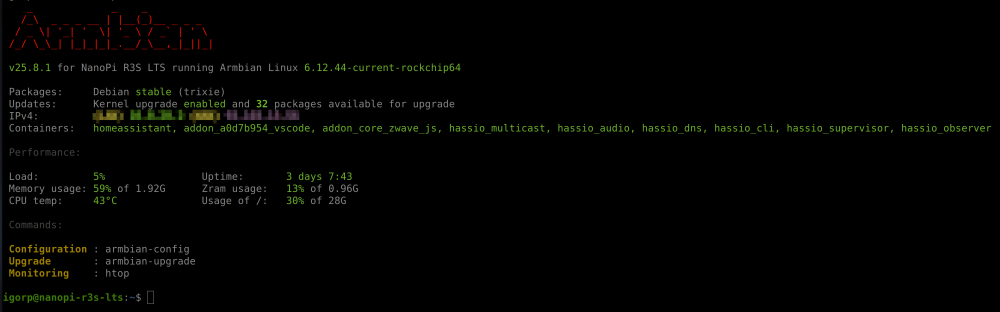
Reboot to enable AppArmor left a system not accessible via ssh after more than 100s. Do we have to wait somewhat longer, or is there currently an issue with the installation of Home Assistant on Armbian Trixie ?
I am running mine on Trixie, installed about a year ago. Then it worked ...
 7 hours ago, ebin-dev said:
If that installation does not work out of the box I will leave it for now as it would not provide a solid basis for the automation of an entire home.
Core is running inside Docker container so functionality should be O.K., but we might currently have some problem ... I will look into this when I am about to reinstall my setup, but I plan to add Docker install only, which should work well, but it has certain limitations.8 hours ago, ebin-dev said:I switched from NetworkManager to systemd-networkd.
HA supervised needs Network Manager AFAIK. No idea why, didn't look deeper. -
15 minutes ago, magostinelli said:
discovered that the problem is uboot related. It started after updating to the last stable armbian version.
There has been several improvements that hasn't landed to stable images yet - try rolling releases for this board. -
On it. Coming soon.
-
59 minutes ago, akabulous said:
radio silence for over a week seems completely inappropriate
We understand the concern, and we appreciate the effort put into testing and documenting the issue. At the same time, it is important to understand the realities of the embedded Linux ecosystem. Armbian supports a very large combination of SoCs, vendor kernels, boot chains, and downstream modifications across several hundred boards. Security response and validation in this environment is significantly more complex than in standardized desktop/server distributions.
Explained here:
https://github.com/armbian/build/issues/6937#issuecomment-4366571379This is not a matter of ignoring the issue, but of limited engineering resources, kernel fragmentation, and the high cost of validating fixes safely across multiple platforms. Project can only finance security from your contributions https://github.com/sponsors/armbian volonteers or sponsors. Until none is taking this seriously, there is little what existing team members can do.
We already attempted mitigation work on one of the most widely used kernel branches:
https://github.com/armbian/linux-rockchip/pull/475 but even targeted fixes require substantial testing effort and may (i am sure it will) introduce regressions on affected hardware families.
Current resources barely sustain even our regular release and maintenance process:
https://docs.armbian.com/Process_Release-Model/For users who need receiving upstream fixes faster and are willing to accept a higher risk of regressions on hardware feature breakage, there is always an option to switch to rolling/daily builds, where fix may already be available:
https://docs.armbian.com/User-Guide_Armbian-Config/System/#rollingTradeoff between stability, validation cost, hardware compatibility, and update speed is unfortunately a sad reality of embedded Linux maintenance.
-
Just a small note here - I recently added Bianbu desktop (can be installed from armbian-config), where acceleration works on K1 based Musebook (legacy kernel). This should be possible to adopt to any other K1 board. Youtube video works fine in Chromium ...
-
For Ubuntu Resolute desktops you need to build from this branch:
https://github.com/armbian/build/pull/9683
It is a matter of days when this will be merged. You can speed this process by reviewing the code.P.S.
We lack 1-2 beefy arm64 servers or 30-40k $ and unknown $ for storage space as we would need to upgrade from free storage which is limited to 1000 artifacts in order to provide more build combinations. We are far away ... -
On 1/30/2026 at 1:53 AM, DogancanYr said:
but it didn’t work.
You need to provide more informations. I wasn't able to repreoduce. I works here. -
49 minutes ago, sugatam said:
Is this intentional?
What you’re seeing is open-source maintenance in practice. It’s not centrally orchestrated. We only manage to do this for some key features while DVB support is present in some kernels, but it’s not guaranteed to be consistently enabled across all targets unless someone explicitly maintains this functionality.
-> https://github.com/armbian/build/pulls -
2 hours ago, norbiv8 said:
desktop images
https://docs.armbian.com/User-Guide_Armbian-Config/System/#desktop
Should be straighforward to enable desktop on top of CLI. -
We have information on which mirrors are good and which bad. We just don't display it. Good are passed to the redirector.
BTT Pi - ethernet not working after upgrade from 6.12.68 to 6.18.33
in BIGTREETECH CB1
Posted
It should be / it was reported fixed a week ago, but you need to make image on your own or use nightly automated builds.