
Active threads
Showing topics posted in for the last 365 days.
- Past hour
-
Note that if you enable USB3, it disables PCIe. That's a hardware limitation of the a5e, I'm told...
- Today
-
Board that would fit though, the H4 PLUS from hardkernel, limited to 4 sata instead of 5. 120x120, but only 2 screws would fit I believe...
-
Update, this is also working .... extraargs=reboot=watchdog UPDATE: It stopped working after 3 successful reboots...
-
Ok update.. I used a USB Ethernet to update and now the local phy is showing as end0 and it works. I'm kind of doubting my story now. I know the initial login could not connect to the Ethernet. After I installed on the local emmc and upgraded via apt upgrade things work now. I think this is a non-issue.
-
Some of the Board manufacturers SDK's broke due to a deleted repository; looks like someone's having a rough end to the year.
-

Dec 25th image for Cubie a5e is not a bootable image
eselarm replied to Meestor_X's topic in Allwinner sunxi
There is at least no primary GPT, all zeros from 0x200-0x20000 Fixed with: # gdisk Armbian_community_26.2.0-trunk.130_Radxa-cubie-a5e_trixie_edge_6.18.2_minimal.img GPT fdisk (gdisk) version 1.0.10 Caution: invalid main GPT header, but valid backup; regenerating main header from backup! Warning: Invalid CRC on main header data; loaded backup partition table. Warning! Main and backup partition tables differ! Use the 'c' and 'e' options on the recovery & transformation menu to examine the two tables. Warning! Main partition table CRC mismatch! Loaded backup partition table instead of main partition table! Warning! One or more CRCs don't match. You should repair the disk! Main header: ERROR Backup header: OK Main partition table: ERROR Backup partition table: OK Partition table scan: MBR: protective BSD: not present APM: not present GPT: damaged **************************************************************************** Caution: Found protective or hybrid MBR and corrupt GPT. Using GPT, but disk verification and recovery are STRONGLY recommended. **************************************************************************** Command (? for help): w Final checks complete. About to write GPT data. THIS WILL OVERWRITE EXISTING PARTITIONS!! Do you want to proceed? (Y/N): y OK; writing new GUID partition table (GPT) to Armbian_community_26.2.0-trunk.130_Radxa-cubie-a5e_trixie_edge_6.18.2_minimal.img. Warning: The kernel is still using the old partition table. The new table will be used at the next reboot or after you run partprobe(8) or kpartx(8) The operation has completed successfully. -
Interesting question. The dxf says the part in question is labeled ED1 besides CP18 and CP14. I found both CP18 and 14 in the schematics but ED1 not. Either mislabeled or I didn't catch it. https://x.na4.eu/KOTu3/quzevoji80.jpg OrangePi-Schematic of ZERO3.pdf
-

install bookworm 6.6.63 on x96q pro+ h728
San Dich Huu replied to hamidreza h's topic in Allwinner CPU Boxes
@Nick A, @MeJune Luckly. On this thread: https://forum.manjaro.org/t/allwinner-h728-a523-a527-t527-initial-support-thread/173654/2 He working for a year to make the linux working stable on this box. This mean kernel, dtb, ... can be replace on armbian build. I super need new image for web-service hosting purpose. Hope all function working. -
Need help with video decode acceleration on NanoPi R6S
eselarm replied to Blind55's topic in NanoPi R6S/R6C
My NanoPi-R6C came with FriendlyWRT pre-installed (OpenWRT variant) and I bought it 2 years ago partly also because I had a Samsumg 970 Evo NVME that needed a computer wrapped around it. I do not use images, instead root-filesystems (Btrfs). I Initially kept the FriendlyElec U-Boot, with all rest on NVME. Now still use the same principle, but EDK2-UEFI v1.1 as bootloader in eMMC and Armbian Trixie or Opensuse Tumbleweed with Armbian kernel and grub-efi. With latest u-boot (2026 rc2) I get no HDMI audio. I thought it was a power/reset issue, but also later tested again with complete un-powering first, but then also no HDMI audio. It might simply be a latency issue. Both older U-Boot and even much older FriendlyElec U-Boot as well as EDK2-UEFI initialize HDMI before the kernel and do simple 1080p60, so you also see the kernel being loaded, before KMS (re)-inits the HDMI. EDK2-UEFI has GUI for its settings, so no surprise it works there. For Jellyfin, I currently use a ROCK5B Armbian Trixie with Armbian vendor 6.1.115 kernel (also EDK2-UEFI bootloader). There were some issue with Jellyfin strreaming/transcoding, also on N100, I currently don't know why/what. The jellyfin-ffmpeg via CLI works great though, so about 5x realtime transcoding HEVC->H264. But Firefox on N100 or x5-Z8350 uses HEVC HW decoder, so no real need to do transcoding for me. LibreElec a month ago or so on NanoPi-R6C temporary booted from SD-card did do HW decoding OK, except for VP9 it was artifacts, not usable actually. So there is unfortunately no easy 1-size-fits-all currenlty. You can scan the forum, there are people who took unfinished patches and use very latest unstable Debian stuff, then things might work same as for x86. -

How to add private package to image?
Werner replied to Tim Zhang's topic in Advanced users - Development
Easiest approach is the customize-image.sh script in userpatches/. https://docs.armbian.com/Developer-Guide_User-Configurations/#user-provided-image-customization-script -
 Finally, build successful on Ubuntu Noble.😃
 -
moved to feedback
-

BPI M4 Zero 2G EMMC 8G H618 MCP2515
Netcrusher replied to Александр Архангельский's topic in Banana Pi M4 Zero
This spi-mcp251x.dts made me use can0 with SEENGREAT Dual-CH Can Hat on latest Armbian v25.11.2 for BananaPi BPI-M4-Zero running Armbian Linux 6.12.58-current-sunxi64: /* * Device tree overlay for mcp2517/18 @ can0 on SPI1.0 (BananaPi Zero M4) / Works with SEENGREAT Dual-CH Can Hat (can0 only) */ /dts-v1/; /plugin/; / { compatible = "allwinner,sun50i-h616"; fragment@0 { target-path = "/"; __overlay__ { can0_osc_fixed: can0_osc_fixed { compatible = "fixed-clock"; #clock-cells = <0>; clock-frequency = <16000000>; }; }; }; fragment@1 { target = <&pio>; __overlay__ { can0_pin_irq: can0_pin_irq { pins = "PC2"; /* Pin 22 on BananaPi BPI-M4-Zero */ function = "irq"; bias-pull-up; }; }; }; fragment@2 { target = <&spi1>; /* Use SPI1 */ __overlay__ { #address-cells = <1>; #size-cells = <0>; mcp2518fd@1 { compatible = "microchip,mcp2515"; reg = <0>; /* Use SPIx.0 */ pinctrl-names = "default"; pinctrl-0 = <&can0_pin_irq>; spi-max-frequency = <10000000>; interrupt-parent = <&pio>; interrupts = <2 2 0x08>; /* PC2 IRQ_TYPE_LEVEL_LOW */ clocks = <&can0_osc_fixed>; status = "okay"; }; }; }; }; Create file: sudo nano /boot/dtb/spi-mcp251x.dts Add overlay: sudo armbian-add-overlay /boot/dtb/spi-mcp251x.dts Edit armbianEnv.txt: overlays=bananapi-m4-pi-5-6-i2c0 bananapi-m4-sdio-wifi-bt bananapi-m4-spi1-cs0-spidev spi-mcp251x param_spidev_spi_bus=1 dtparam=spi=on param_i2c_arm_baudrate=10000 I did not try to get can1 to work since I don't need it at the moment. I hope it helps. Have fun! -
I’ve been testing Armbian on an Amlogic-based TV box, and wanted to share a short user experience. The device originally runs Android, but thanks to the Amlogic S9xx platform, it can boot Armbian from an SD card without touching the internal firmware. In my case, the system booted reliably and was usable for basic tasks like SSH access, light services, and general Linux testing. Ethernet and USB worked out of the box, while Wi-Fi and power management still required some manual tweaks, which seems common for community-supported TV boxes. For reference, the hardware I used belongs to the category of Amlogic TV boxes that are widely available on the market. These devices are not officially supported by Armbian, but they can still be interesting low-cost platforms for learning, testing, or small home projects. I’m curious if others here have experience with Armbian on similar Amlogic TV boxes, and which SoCs or configurations worked best for you.
-

Booting Armbian without EMMC
Kevin Putra Satrianto replied to Kevin Putra Satrianto's topic in Amlogic CPU Boxes
I see. Is this a hardware enforced security feature of sort? Because according to: https://docs.u-boot.org/en/latest/board/amlogic/boot-flow.html, the s905x2 can read the bootloader from sd card no matter the configuration. Only the order differs. I'm now trying to compile u-boot down from BL2 up to BL33 using this closest match of a board. It has a ddr4 memory while mine is ddr3l, but as shown in the doc it also includes ddr3 firmwares so I *hope* this will work. https://docs.u-boot.org/en/latest/board/amlogic/sei510.html However, if I'm talkin nonsense please let me know. This is my first dive into u-boot or bootloaders in general. -
Wow, thank you for this comprehensive answer. It will probably take me about as much time as until 6.19 is released to try and understand it 😂 Why does this say archlinux? And also, where to get these "idbloader.img" and "u-boot.itb" files from? The console is ttyS0, it works.
- Yesterday
-

Have Armbian for Tanix TX1 QHZIW_H313_TX1_EMCP_V2.0?
Nick A replied to Lesano's topic in Allwinner CPU Boxes
@Lesano https://linux-sunxi.org/Tanix_TX1 shouldn’t be hard to make a armbian config for this board since it's mainlined. You probably want this patch to add wifi and hdmi. https://gitlab.manjaro.org/iuncuim/linux/-/blob/eccecabc2ca2d6efb463edc94aa0ef383d8ae200/0650-arm64-dts-allwinner-h313-Tanix-TX1-TVbox.patch You would need to boot over USB cable. I never booted over USB so I can't help with that. https://linux-sunxi.org/FEL/USBBoot -
I couldn't find this documented specifically, but I confirmed this was the case via testing. Google also provided an AI summary which also stated that this was the case. I enabled `iptables-legacy` in the Armbian kernel builder which then resolved the errors I was getting. I also eventually realized through further research that `nftables` were also supported and available as a module out of the box. I wound up changing my Microk8s config to use `nftables`, which also worked out and is where I left my config today. Hopefully this is helpful for someone else in the future. Somewhat relevant articles: https://github.com/canonical/microk8s/issues/2180 https://github.com/canonical/microk8s/issues/4387 https://hub.libre.computer/t/missing-iptables-kernel-configs-for-microk8s-calico/3717
-
 i also tried installing network manager separately, however it is not able to override the wifi configurations. It was allowing in image files few months ago. But now it does not allow.
 -
 In the past (2019) there was no chance to use the A64-CPU Jide Remix Mini with armbian, because of a blocked -u-boot But today I found a site (from February 2025 on github) https://github.com/r4nd3l/revived_remix_mini_pc?tab=readme-ov-file which can make the Closed Jide Remix Mini to boot from SDCard with a modified u-boot There at the github page is a modified u-boot and a modified A64 armbian for the Jide Remix Mini. Jide did leave us with a closed/blocked device AT this time the 16GB emmc isnt useable, but using SDCard is a start for upcycling the Jide Remix Mini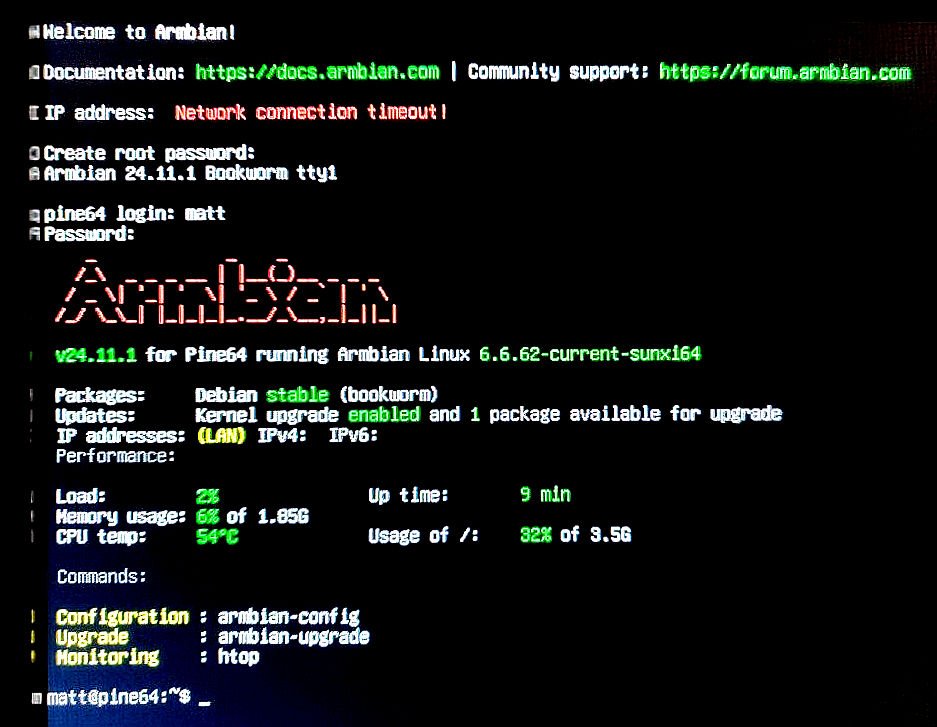
-
This suggests it is 5V only and also no USB-C PD. You should power a ROCK5 with higher voltage, then no issues, at least that is my experience and is also what you can see if you look at schematics. You can also read the end-user docs/wiki. ROCK3A, ROCK5B, NanoPi-R6C all have own step-down DC/DC converter on the board itself. The latter one for example has an 8A component for it. So it can make enough power from 20 or 15 Volt input at a perfect 5V internally for USB devices on its type-A ports, and also easily maintain its 3.3V and lower voltages for CPU etc. OrangePi is cheap, same as RaspberryPi. Those shift the powering (issues) to the end-user, meaning you need a stable enough 5V on the USB power input connector. A slight voltagedrop can lead to problems. But board itself is cheap. RPi5 requires a quite rare 5A capable 5V USB-C PD (RPI5), where the ROCK3A/5B can just be fed from any voltage between 9 and 20 Volt (see docs/wiki). If you use 5V, the on-board DC/DC step-down cannot do its work of course, so essentially bypassed. Why did you buy a ROCK5 then. Same as buying a car with combustion engine with empty fuel tank, instead put a horse in front to pull you forward from A to B. (Or get a bicycle). The (extra) horse is the 27W Pi5 PSU here, costed me 18 Euros, half the price of the ROCK3A. I put a fixed 12V on a USB-C connector, from an old card battery, that by itself is kept at about 12V by a 12V/10A generic powerbrick. Is also UPS then is no 230VAC mains. The Nanpi-R6C with latest U-Boot and latest mainline kernel does also do USB-C PD, so with a generic 45W USB-C PD PSU, is flips automatically to 15V on its USB-C input. With another 60W USB-C PD PSU it was 20V. ROCK5B should be able to do the same, but haven't tried as run 24/7 for months as home/house server.
-

Installation Instructions for TV Boxes with Amlogic CPUs
Maurizio Finesso replied to SteeMan's topic in FAQ
Hi guys and Happy Christmas. I found something that could be useful. I had trouble due to fake sd card that report fake capacity. Capacity declared 64 Gb real capacity 3.7 GB. H2testw (windows) will show you the real capacity. Don't trust if it is a known brand because there are companies with machine to fake SD card. After another problem that I found is not to see the boot partition after imaging SD card. I don't know why but you must be sure that your imaging program (balena etcher o pi imager or rufus) are run in admin mode. after that in any case if it doesn't appear you have to assign a letter drive (sometimes it is not assigned) I used aomei partition manager) -

DM_CRYPT module unavailable in initramfs after update to 6.1.115
The Tall Man replied to David Zarebski's topic in Beginners
I've used an encrypted root in my configuration. I've found earlier versions of the vendor kernel to not include dm_crypt, so I've always used the edge kernel. That one's been quite reliable with encryption. If you're using serpent encryption, that's one that's more likely missing than the others. Run this to see if serpent's missing (from your (vendor) kernel): cryptsetup benchmark If serpent is missing, it will report N/A instead of a speed for that one. If you really want to use a vendor kernel, you can build it yourself... being sure to include dm_crypt, and if necessary, a serpent encryption module. - Last week
-

Help wanted to test a new OpenVFD alternative
blackc replied to Jean-Francois Lessard's topic in Amlogic meson
I was rechecked that openvfd works and get its config openvfd dtbo overlay fragment (decompiled on running system) It works, driver loaded and userspace software shows me current time on LED (some segments shows wrong, i think it result of wrong chars config) tm16xx: I've tried many values for GPIO line config, GPIO_ACTIVE_LOW (1), GPIO_ACTIVE_HIGH | GPIO_OPEN_DRAIN (6), GPIO_ACTIVE_HIGH (0), GPIO_ACTIVE_LOW | GPIO_OPEN_DRAIN (7). It was no result at all, driver still says that cannot init controller. Also i was tried drivers fd6551, fd655 with different GPIO lines config. No success. I was rechecked LED controller chip on board, it is really FD6551. tm16xx dtbo overlay fragment (decompiled on running system) I have no ideas what goes wrong. When i was configure openvfd device tree, pointing gpio chip as &gpio was not works. Only pointing as "0300b000.pinctrl" was successful. Maybe, its important... Maybe, some features/conflicts at controller init needs debugging -
@robertoj I apologize, perhaps you missed the message.