Active threads
Showing topics posted in for the last 365 days.
- Today
-
I did not look well enough and also at a local PDF copy of the wiki which I see is more than 2 years old. Same text is there, but not in red at that time. I think I noticed it at the I was soldering the wire, but I clearly forgot the typing the message i this topic. Anyway, I have no good idea how to solve your remote power issue. I use a MOSFET that has low Vgs on (works directly on 3.3V , but is not for common GND. Else PoE managed switch where I can toggle power when fatal lockup or so. Or else instruct someone to pull the plug, wait 10 seconds, stick it back in again. If you use CoW filesystems, it is no problem to do this.
-

CSC Armbian for RK3318/RK3328 TV box boards
andrey.lobov replied to jock's topic in Rockchip CPU Boxes
Hi all, I’m trying to enable the front VFD/LED display on an RK3318 TV box. OS: Armbian 23.11.1 Jammy, kernel 6.18.10-current-rockchip64 DTB: rk3318-box.dtb (fdtfile=rockchip/rk3318-box.dtb) In DTB I found: fd628_dev { compatible = "fd628_dev"; fd628_gpio_clk = <0x7a 0x10 0x00>; // bank2, offset16 fd628_gpio_dat = <0x7a 0x0f 0x00>; // bank2, offset15 }; I built linux_openvfd and added an openvfd node in DTB: openvfd { compatible = "open,vfd"; dev_name = "openvfd"; status = "okay"; }; Module loads, /dev/openvfd appears with: vfd_gpio_clk=2,16,0 vfd_gpio_dat=2,15,0 vfd_gpio_stb=2,19,0 vfd_display_type=0,0,0,0 vfd_chars=0,1,2,3,4,5,6 vfd_dot_bits=0,1,2,3,4,5,6,0 dmesg shows: OpenVFD: Select FD628 controller OpenVFD: SPI 3-wire interface initialized (LSB mode) /sys/class/leds/openvfd exists, but no indicators light up. Tried multiple display_type values and STB pins (bank2 offsets 18–22 + other banks) — still no output. Question: Does anyone know the correct GPIO pins (CLK/DAT/STB) for rk3318-box VFD, or a working driver/service for FD628/FD650 on this board? Any confirmed configs for RK3318 boxes would be greatly appreciated. I’ve been working on this for ~2 weeks and tried multiple configs/drivers without success. Thanks! -

Installation Instructions for TV Boxes with Amlogic CPUs
Thiago Escaliante replied to SteeMan's topic in FAQ
One interesting thing I discovered today is that you can actually boot from a flash drive, if you don't have a SD Card! In my case, I would have to buy a SD Card and had a flash drive laying around so I thought I might just give it a try, worked on an Arm Cortex-A53 CPU. I used u-boot-s905x-912 for .ext and meson-gxl-s905x-p212.dtb. -
Btw. do you know if: 1. Is it possible to use the internal dvb-s tuner in the wetek play 2 with tvheadend? "dmesg | grep -i dvb" showed nothing (an external usb dvb-c wintv solohd was found). 2. Is hardware acellerated "Moonlight Gamestream" possible? In newer/latest Libreelec, the Wetek Play 2 Tuner isnt supported and hardware accelerated x264 is buggy. I think these problems also exist in armbian, or? 🙏
-
 Thanks @bedna Ive now got it working with read write execute on the share via Windows. I searched the Ubuntu forums and foud a couple of posts relating to the issue I was hving with an exfat formatted hard drive. For anyone else searching this forum the answer was to edit the fstab file as follows: To enable read-write access for an exFAT drive in /etc/fstab, add rw,uid=1000,gid=1000,umask=000 to the options field. Using umask=000 ensures all users have read/write access, while setting the uid and gid to your user ID (typically 1000) assigns ownership to your account. Also from Reddit Linux Add this to your /etc/fstab file (replacing the UUID and mount point): UUID=XXXX-XXXX /mnt/exfat exfat defaults,uid=1000,gid=1000,umask=000,nofail 0 0 Key Options Explained rw: Explicitly mounts the drive as read-write. uid=1000,gid=1000: Sets the user and group owner to your user account, preventing root-only lockouts. Use the id command to check your actual UID if needed. umask=000: Sets permissions to 777 (read/write/execute for all), which is usually necessary because exFAT doesn't support native Linux permissions. nofail: Allows the system to boot even if the drive is unplugged. To remove the guest share that appeared all I did was remove the [Global] settings inserted from the Samba wiki i.e. [global] map to guest = Bad User log file = /var/log/samba/%m log level = 1 server role = standalone server [guest] # This share allows anonymous (guest) access # without authentication path = /srv/samba/guest/ read only = no guest ok = yes guest only = yes All working correctly now. I just need to mount the board in a small plastic box and change the IP address to a static one on my daughters subnet.🙂
 -
https://paste.armbian.com/xacimaxamo here's the output from the build from Bigtreetech repo (https://github.com/bigtreetech/build)
-

status of armbian-configng?
Igor replied to jimg's topic in Framework and userspace feature requests
Did you ran apt update + upgrade + reboot before ? Edit: we might add warning if installed and running kernel version differs. I ran into this problem myself. -
 I was using hdmi cable on hdmi port to only hours later discover that it is hdmi INPUT port, the hdmi output is a usb-c type.
 -
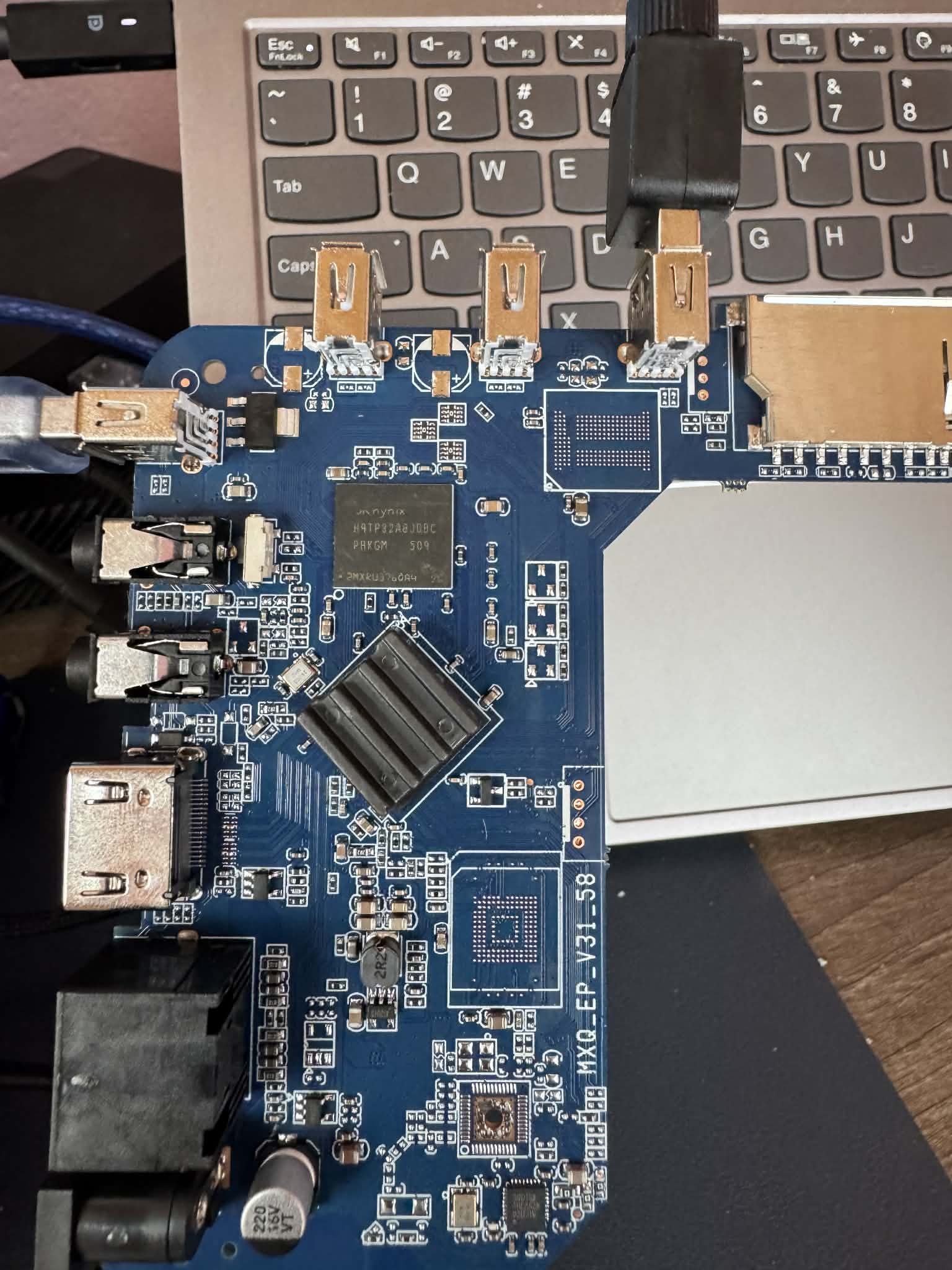
Hi everyone, I'm using a new MXQ box with the SK Hynix H9TP32A8JDBC-PRKM but after flash the bootloader rk322x_loader_v1.10.238_256.bin, rkdeveloptool only detect ~4GB of flash with manufacturer name is SAMSUNG. How can I fix this? Thanks!
- Yesterday
-
Thanks Werner, Unfortunately I have to halt this project. Though I can now create an booting Neo3plus Armbian image based on the Zero2, it does not fit my initial requirements. Obviously u-boot requires an android partition scheme. The current version as used by the nanopi zero2 cannot be used for my own purposes. So it will need to wait until the board can boot without a vendor u-boot version.
-
--deleted--
-
 Google's AndroidXR. Qualcomm's Snapdragon Spaces. NVIDIA CloudXR. What do they have in common? Monado, the Open Source, cross-platform OpenXR runtime Collabora launched as an alternative to proprietary XR stacks. View the full article
 -
I tried to build a image from the current main branch (kernel: 6.18.20) and I found the problem is the same. I changed KERNELBRANCH to "tag:v6.18.18" from "branch:linux-6.18.y" and rebuild. It can boot to desktop as expected. It seems some change in the 6.18.19 kernel causes the problem
-
Thanks I got it.
-
Found an error in the "use proprietary GPU driver for Spacemit K1" script. Because I cannot edit here is the corrected install script. spacemit-gpu-addon.sh
-
I have 3 Aceline AG-216 consoles. Help me find the right image for her. QHZIW_H313_A3_2LP4. V2.0 20240603 EA6521QF 2+16G
-
Maybe. Trunk are untested auto-builds and support for this board is from the community. Its functionality is unknown to the Armbian team. Get serial console logs. This makes investigation way easier.
-

How to receive MIDI messages to a cli app
samlevy0515 replied to Vivichrist's topic in Software, Applications, Userspace
Try running a2jmidid with pw-jack a2jmidid first — that bridges ALSA MIDI to JACK MIDI, and then use pw-link or qpwgraph to connect your app's MIDI input to the resulting Midi-Bridge ports -
I was able to run Steam games with GPU accelerated ofc. But since my Opi5 only has 8Gb, I mainly run non-Steam games. I can see your SBC has 32Gb, so you are good. I assume your game is 64-bit DX11. Change the Steam Play compatible layer to "GE-proton". Download Dxvk-stripped here: https://github.com/khanh-it/dxvk/releases/tag/releases Copy x64/d3d11.dll, x64/dxgi.dll to the <<game>>.exe folder. Then run the game with a command like so:
- Last week
-
Hey there, Title: Need compatible firmware / loader for XR8223518K-V1.0 (RK3518) TV box Message: Hi, I’m trying to recover a TV box with this exact mainboard: Board code: XR8223518K-V1.0 SoC: Rockchip RK3518 Symptoms: device only shows blue LED no HDMI output device can still enter MASKROM / Rockusb mode What I already tested: RKDevTool detects “Found One MASKROM Device” using my current MiniLoaderAll.bin + ExportImage.img fails with: “Download boot fail. Please check DDR.” So I believe I need: the exact stock firmware for this board or a compatible RK3518 MiniLoaderAll.bin / loader for this exact board / DDR configuration If anyone has firmware, loader, dump, or files for XR8223518K-V1.0, I would really appreciate it. Thanks.
-
@boggy have you tried another SD card? You have a lot of mmc errors. which miniarch image booted for you? Maybe we can use the mmc settings from that image.
-
I opened PR #9590 with the really minimal change that's needed to get my desired behavior back.
-
Diagnosing System Issues and Getting Support with ArmbianmonitorArmbian is a lightweight operating system based on Debian/Ubuntu, highly optimized for single-board computers (SBCs) like the Raspberry Pi, Orange Pi, and many others. When facing system problems on an SBC running Armbian, the built-in utility armbianmonitor is an essential diagnostic tool. It quickly gathers crucial system data, making troubleshooting faster and more accurate for both the user and the community providing support. Key Diagnostic FunctionsThe primary use of armbianmonitor is to generate real-time performance and system configuration reports. By running the command without any arguments, you get a menu of options, but the most vital functions for diagnosis are: System Status (armbianmonitor -m): This provides a live monitoring dashboard. It displays key metrics like CPU frequency, load average, temperature, memory usage, and disk I/O. By watching this output while a problem (like a system freeze or slowdown) occurs, you can often pinpoint the bottleneck—for instance, a sudden spike in CPU temperature indicating a cooling problem, or sustained high memory usage pointing to a resource leak.System Information (armbianmonitor -u or -d): This is the most crucial function for seeking online support. It gathers a comprehensive, anonymized report including details about the kernel version, device model, installed packages, boot logs, and hardware configuration. This data is essential because the performance and stability of SBCs are often highly dependent on the specific kernel and hardware drivers used for that model.Getting Support OnlineWhen seeking help on platforms like the Armbian forum or GitHub, simply describing the symptoms is rarely enough. The person helping you needs to know the exact state of your system. By running armbianmonitor -u, the utility uploads the detailed diagnostic report to a public pastebin service (like https://www.google.com/search?q=paste.armbian.com) and provides a unique, short URL. You can then include this URL directly in your support request. This allows community members to instantly access the exact configuration, eliminating back-and-forth questions about device type, OS version, and log file locations. This standardized method is the fastest way to receive targeted, effective assistance and ensures your issue is diagnosed accurately. View the full article
-
Nice! I actually did something similar. In my case I ended up using an old PWM fan I had lying around, powering it through the 12V pin input. Then I used ground on pin 6 and the PWM signal from GPIO pin 11. I wrote a bash script and set it up as a service that controls the fan speed based on five temperature levels. Right now I’m running it on FriendlyElec CM3588 NAS with Armbian Linux 6.1.115-vendor-rk35xx (v26.2 rolling). The repo is in Spanish for now, but I’m planning to translate it to English soon: https://github.com/jgomezriesgobancario/cm3588-fan-controller **edited** Fix typos
-
https://forums.kali.org/ There is an arm64 section.