All Activity
- Past hour
-
 @Sergioclr can you find a AXP chip on your board? It’s safer to boot images with the same AXP chip. I haven’t bricked any of my boxes. Don’t use armbian-config’s write to emmc until you have a stable image.
 -
@Sergioclryou are only adding one line of code.. so whatever it is just add one. 162 would be 163.
-
 Update: I finally was able to compile the H98H example and write it to SD card (Armbian Imager). The SD firmware load promptly "bricked" the box! I reloaded the original (secure) image by means of PhoenixSuit software. I am considering building an image using sun50i-h313-x96q-ddr3-v5.1.dts but I don't know how to customize the "@@ -0,0 +1,162 @@" parameters. Could you help me? Thanks in advance.
 - Today
-
@qq20739111 I'll add it soon. 6.18 might take awhile.
-
@Nick A Is it possible to release a system for Radxa Cubie A7S?
-

Raspberry Pi 5 missing video decode hardware acceleration in chromium
LivingLinux replied to otte's topic in Raspberry Pi
It will only work for h265, as that is the only hardware decoder available in the Pi 5. So it won't help you with for instance YouTube, as they use VP9 and AV1 (or you can force h264 with a browser plugin). You can try Firefox. https://bugzilla.mozilla.org/show_bug.cgi?id=1833354 Or change some of the flags in Chromium, but it feels as if they keep changing, so you might find other suggested flags all over the internet. You can set the mentioned flags in: chrome://flags/ https://bbs.archlinux.org/viewtopic.php?id=244031 -

Raspberry Pi 5 missing video decode hardware acceleration in chromium
geoW replied to otte's topic in Raspberry Pi
How to Change hardware configuration? Use /boot/firmware/config.txt to configure hardware settings. This is the official Raspberry Pi method. From https://www.armbian.com/rpi4b/ I assume same for your gpu settings. -
@sven-ola it works with official ubuntu image and with debian 13 image from romanrm, so this ssd is 100% works
-
 Then it should not be an issue to find somebody from the community to come up with support. From official POV we do not add new boards without some sort of funding. Our resources are simply too limited.
 -
 thank u, but I think this board will be a hit soon
 -
No official plans. However anyone from the community can step up and add support for new boards
-
@savznkvo Besides rust, dust or wrongly inserted: that may be one of those NVMEs that needs tweaking e.g. has an ASPM issue, search for "ASPM" on page one of this thread. You may also check with lspci if there is a PCI device (beside PCIe bridges). If it does not show up as /dev/nvme?n1 in a standard PC, that may be one of those mSATA SSD with an NGFF (M.2) form factor. HTH // Sven-Ola
-
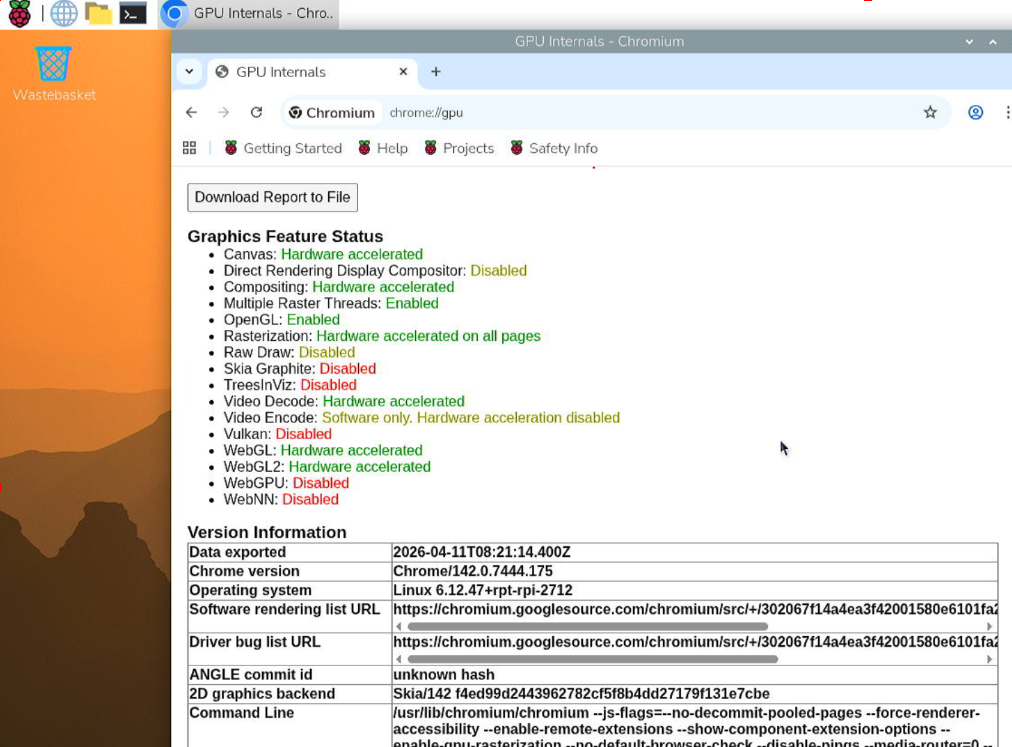
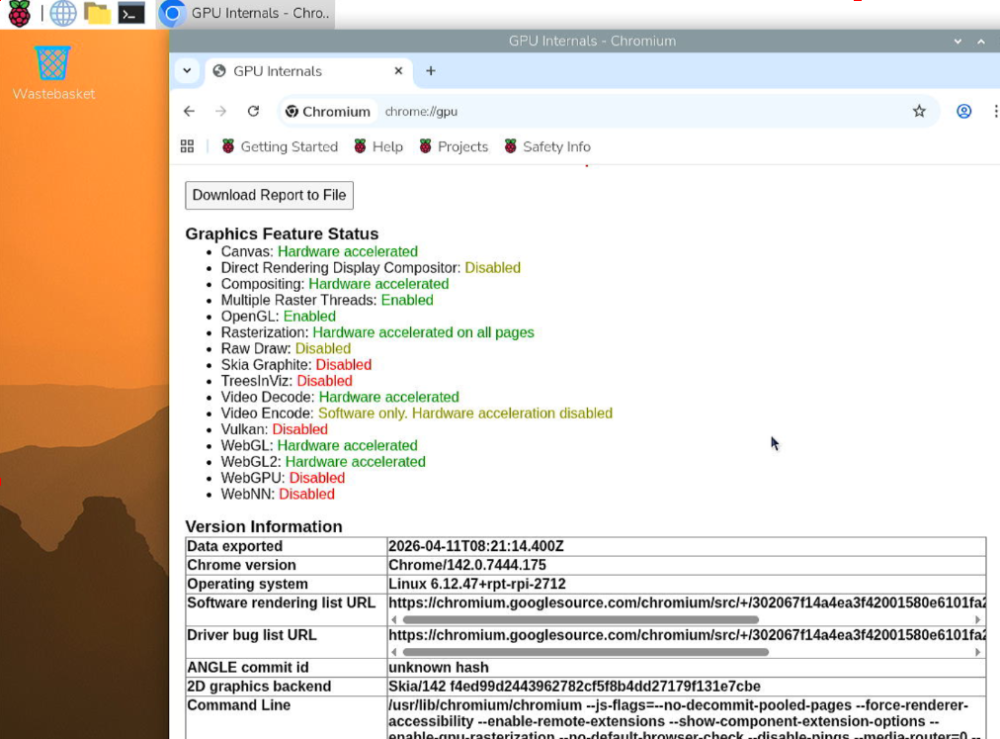
 Greetings, I installed Armbian Noble with gnome desktop, specifically "Armbian_26.2.1_Rpi4b_noble_current_6.18.9_gnome_desktop.img" on a Raspberry Pi 5. Updated system and installed chrome since I need to play some media from inside chromium browser. However, I checked to see that hardware accelerated video decode is not actually supported within Armbian currently. Previously I had official Raspberry Pi OS installed when I first had a look at the device and there it was enabled. It's kind of a minor thing but I've used different hardware with Armbian before and it would make things a lot easier for me if I can keep using Armbian on Raspberry Pi 5 as well. Only hint I've found on forum so far was a post from 2024 but it seemed to affect hardware acceleration in system overall and was a known issue, so I believe this is a new topic. Other thing I still tried was to go with a rolling release instead of Standard support, in this case "Armbian_26.2.0-trunk.679_Rpi4b_noble_current_6.18.20_gnome_desktop.img" but same issue. Any ideas on what can be done here, perhaps a setting or package I might have missed?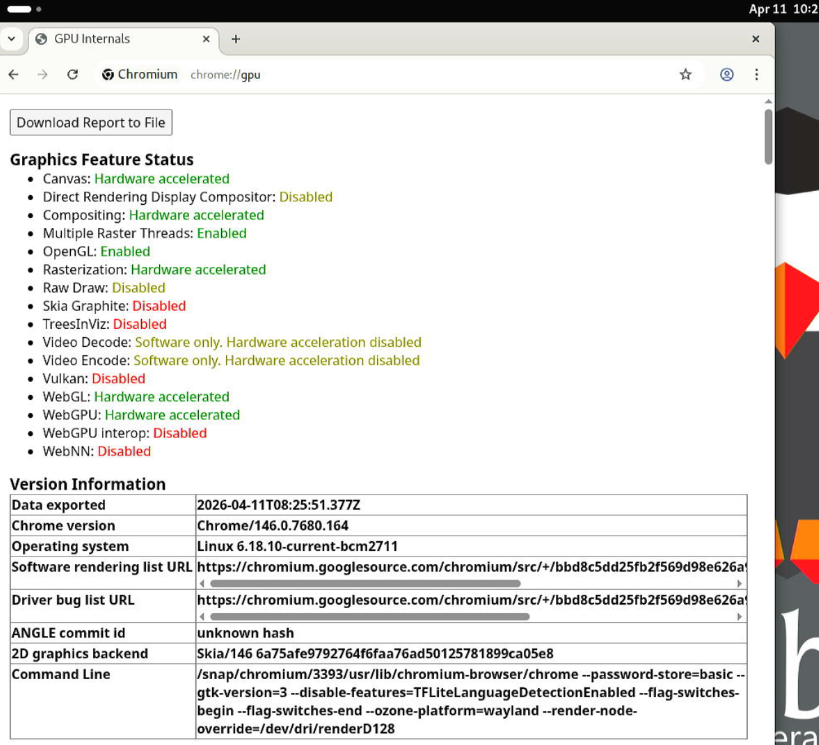
-
Are there any plans to create an Armbian image for the Radxa Cubie A7S? It's a really cute single-board computer with a powerful Allwinner A733 SoC.
-
@sven-ola I didn't get it at all about "Transfer *.img to /dev/nvme0n1, use netcat or similar", also in my case when I booted from SD card I just can't interact with my M.2 SSD, Always got Invalid Operation error.
-
hey i seem ho have same exact issues have you found any fix yet!
- Yesterday
-
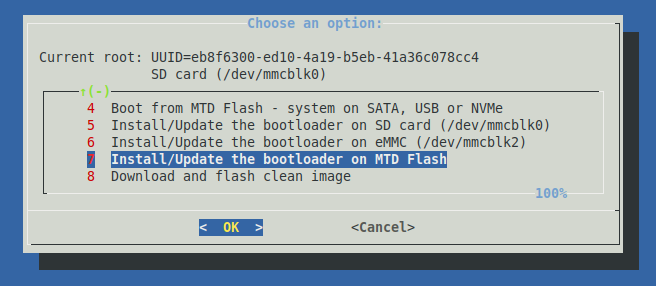
@savznkvo if you followed my compile.sh steps from above, you should have a file Armbian-unofficial_26.05.0-trunk_Orangepirv2_trixie_current_6.18.21_minimal.img in ./output/images ready to be flashed to your SD card. Insert and boot. At this point you need TV / Kbd or UART to finish the wizard (set root PW etc). Now start armbian-install (see screen shot). Transfer *.img to /dev/nvme0n1, use netcat or similar. Then power down, remove SD and eMMC (if plugged). Restart from NVME, now you have to complete first time wizard again. Tested with current main and it works flawlessly. Addon: if you apt-get dist-upgrade, a newer kernel package from Armbian nightly builds is installed and the bcmdhd wifi kernel driver module is recompiled - which needs some time. This will DOWNGRADE from 6.18.21 to 6.18.20 currently - this works as designed. HTH // Sven-Ola
-

Armbian_24.11.2_Orangepi5_noble_current_6.12.0-kisak NPU driver version
usual user replied to thanh_tan's topic in Rockchip
From an OS's point of view, only a Mesa build with Teflon and Rocket driver support is needed (available since Mesa 25.3). Inferences can then be executed with ai-edge-litert. I have been experimenting with this for some time on all my devices equipped with Rockchip RK3588/RK3588s. -
@savznkvo Installing headless (blind / via network) on a board this new will fail probably. Get a TV and connect an HDMI display or get a serial adapter and connect that for debug. I'll check later with a spare NVME, but I am pretty sure it works (provided, that you compiled the correct firmware). HTH // Sven-Ola
-
@sven-ola I tried this way too, no luck. Or at least I can't connect to SBC via SSH after.
-
Hello @savznkvo and @Logan. Directly booting from NVME is not supported by the ROM software burned in the RISCV chip. Instead, the OrangePi RV2 chip is able to boot from SD, eMMC, and Flash / MTD (in this order). You need to prepare the board's internal flash for NVME boot with Boot Armbian from SD card. As root, start armbian-install and select "Install to MTD". Transfer a fresh Armbian image to your NVME. If you do not have the "armbianized" MTD boot config installed, @c0rnelius above hints on booting apply. HTH // Sven-Ola
-
Hello @1111Windows! Having a portrait HDMI display is rather unusual. Normally, one can buy landscape HDMI displays and simply rotate them via software or video card hardware. However: if reading out the EDID via I2C / HDMI cable does not work correctly, the HDMI display driver may simply fallback to 1920x1080@60 using the compiled-in EDID. You can try to get the EDID from the display with the apt install read-edid tool. If I recall correctly, one can provide a custom EDID binary as file to the kernel via some boot cmd parameter, see https://www.marcusfolkesson.se/blog/custom-edid-in-linux/ for details. Simply configure some mode via video= when the mode is not available in the EDID will not work (as you already found out). It should also be possible to add a custom modeline, but this is deep dive as stated here: https://nyanpasu64.gitlab.io/blog/crt-modeline-cvt-interlacing HTH // Sven-Ola
-
The armbian boot loader is diff than the vendors. It checks for specific things in a particular order. nvme_devtype=nvme nvme_devnum=0 nvme_bootpart=1 autoboot=if test -e ${devtype} ${devnum}:${distro_bootpart} /extlinux/extlinux.conf; then \ sysboot ${devtype} ${devnum}:${distro_bootpart} any 0x2000000 /extlinux/extlinux.conf; \ elif test -e ${devtype} ${devnum}:${distro_bootpart} /boot/extlinux/extlinux.conf; then \ sysboot ${devtype} ${devnum}:${distro_bootpart} any 0x2000000 /boot/extlinux/extlinux.conf; \ elif test -e ${devtype} ${devnum}:${distro_bootpart} /boot.scr; then \ load ${devtype} ${devnum}:${distro_bootpart} 0x2000000 /boot.scr; source 0x2000000; \ elif test -e ${devtype} ${devnum}:${distro_bootpart} /boot/boot.scr; then \ load ${devtype} ${devnum}:${distro_bootpart} 0x2000000 /boot/boot.scr; source 0x2000000; \ elif test -e ${devtype} ${devnum}:${distro_bootpart} EFI/BOOT/BOOTRISCV64.EFI; then \ load ${devtype} ${devnum}:${distro_bootpart} ${kernel_addr_r} EFI/BOOT/BOOTRISCV64.EFI; bootefi ${kernel_addr_r}; \ fi; nvme part; \ setenv devtype $nvme_devtype; \ setenv devnum $nvme_devnum; \ setenv distro_bootpart $nvme_bootpart; \ if test -e ${devtype} ${devnum}:${distro_bootpart} /extlinux/extlinux.conf; then \ sysboot ${devtype} ${devnum}:${distro_bootpart} any 0x2000000 /extlinux/extlinux.conf; \ elif test -e ${devtype} ${devnum}:${distro_bootpart} /boot/extlinux/extlinux.conf; then \ sysboot ${devtype} ${devnum}:${distro_bootpart} any 0x2000000 /boot/extlinux/extlinux.conf; \ elif test -e ${devtype} ${devnum}:${distro_bootpart} /boot.scr; then \ load ${devtype} ${devnum}:${distro_bootpart} 0x2000000 /boot.scr; source 0x2000000; \ elif test -e ${devtype} ${devnum}:${distro_bootpart} /boot/boot.scr; then \ load ${devtype} ${devnum}:${distro_bootpart} 0x2000000 /boot/boot.scr; source 0x2000000; \ elif test -e ${devtype} ${devnum}:${distro_bootpart} EFI/BOOT/BOOTRISCV64.EFI; then \ load ${devtype} ${devnum}:${distro_bootpart} ${kernel_addr_r} EFI/BOOT/BOOTRISCV64.EFI; bootefi ${kernel_addr_r}; \ fi; bootcmd=echo "Loading K1-X Environment ..."; \ echo ""; \ echo "Running NVMe Scan ..."; \ nvme scan; \ run autoboot SD takes priority. After that it checks for an eMMC and if nothing on the eMMC is found it can use, it then moves on to check the NVMe. What this means? If the unit has an SPI, it needs to be updated with the Armbian boot loader. If the bootloader finds an extlinux.conf, boot.scr or *.EFI on the eMMC it will attempt to boot from it. I have a BPI-F3 which has no SPI. What I do in that case is boot from SD, format the eMMC and transfer the install to the NVMe. I then flash u-boot to the eMMC and wham oh. System boots from NVMe. In the case of an SPI, its the same. As long as it doesn't find anything of use on the eMMC your good.
-
same question here.... we need minimal image... none of solutions in this topic doesn't work
-
reverse engineered npu driver (called ROCKET) is upstreamed since 6.17 I believe. So kernel-wise it is there. Everyhing else necessary (like libraries) is out of scope for Armbian.