
All Activity
- Today
-

[Bug]: Ethernet rarely connecting successfully in Orange Pi 3 LTS
Werner replied to iMagz's topic in Allwinner sunxi
One last attempt. Reverted back to .62 due to upstream regulator handling changes https://testing.armbian.de/Armbian-unofficial_26.02.0-trunk_Orangepi3-lts_trixie_current_6.12.62_minimal.img.xz -
[Bug]: Ethernet rarely connecting successfully in Orange Pi 3 LTS
Werner replied to iMagz's topic in Allwinner sunxi
Bummer. Well. Was worth a try. You can stick with 6.18 for now. -

[Bug]: Ethernet rarely connecting successfully in Orange Pi 3 LTS
iMagz replied to iMagz's topic in Allwinner sunxi
Unfortunately I tested both of the images provided and neither worked. After testing the images I ran the commands that were asked to be run on the following images: Armbian-unofficial_26.02.0-trunk_Orangepi3-lts_trixie_edge_6.18.2_minimal.img [ETHERNET CONNECTION WORKING] (I realized that forky isn't for me so I compile it with trixie which is used for the official images and it also works) Armbian_community_26.2.0-trunk.151_Orangepi3-lts_trixie_current_6.12.63_minimal.img [ETHERNET CONNECTION NOT WORKING] dmesg | grep -i "phy.*halt\|mdio.*reset" In both images it didn't show any output. watch -n 1 'ethtool eth0 | grep -E "Speed|Duplex|Link detected"' Every 1.0s: ethtool eth0 | grep -E "Speed|Duplex|Link detected" orangepi3-lts: Mon Dec 29 21:48:01 2025 netlink error: no device matches name (offset 24) netlink error: No such device netlink error: no device matches name (offset 24) netlink error: No such device netlink error: no device matches name (offset 24) netlink error: No such device netlink error: no device matches name (offset 24) netlink error: No such device netlink error: no device matches name (offset 24) netlink error: No such device netlink error: no device matches name (offset 24) netlink error: No such device netlink error: no device matches name (offset 24) netlink error: No such device In both images it showed this because Armbian use end0 instead of eth0 so I ran it with end0 instead and it showed this: [Ethernet Connection NOT working image] Every 1.0s: ethtool end0 | grep -E "Speed|Duplex|Link detected" orangepi3-lts: [DATE] Speed: Unknown! Duplex: Unknown! (255) Link detected: no [Ethernet Connection working image] Every 1.0s: ethtool end0 | grep -E "Speed|Duplex|Link detected" orangepi3-lts: [DATE] Speed: 1000Mb/s Duplex: Full Link detected: yes cat /sys/class/net/eth0/phydev/phy_state 2>/dev/null In both images it didn't show any output. I think is because not only is end0 instead of eth0, which I tested by changing them, but also there isn't any phy_state file in the /sys/class/net/eth0/phydev/ directory. -
/dev/video0 - usually is the camera V4L driver. Cedrus (sunxi video engine) driver usually is /dev/cedar_dev. Also you can see
- Yesterday
-
https://github.com/twdragon/FFmpeg/tree/cedrus264 may produce green line artefact at the frame bottom on 1080p resolution. In the https://github.com/agustinov/FFmpeg-Cedrus/tree/4.4-cedrus this artefact is fixed.
-
@Marvin-03 Here are the results of the commands provided, hope this help. Thanks for the link of your image builds, will try them out.
-
Can you test these commands in u-boot? mmc list mmc info mmc dev 0 mmc part fatls mmc 0:1 ext4ls mmc0:2 mmc read 0x40000000 0 1 It seems like mega doesnt work anymore without login. Here are the images on gdrive: https://drive.google.com/drive/folders/1jEIWmzZgT5t39jRz7GwZpFOAdjdQBLtG?usp=drive_link
-

How to install desktop
Michael Robinson replied to silencer's topic in Software, Applications, Userspace
if you are not seeing option to enable in armbian-config you can try: sudo apt install xfce4 xfce4-terminal lightdm -y or sudo apt install xfce4-goodies -y -
I experience the same problem: I installed Armbian without desktop (both the Debian and Ubuntu version) to install a minimalistic desktop setup afterwards. However, in the armbian-config tool I do not find the "Desktop" option when entering the "System" menu. The installation instructions mentioned in the documentation (Desktop Environments - Armbian Documentation) are not working either. I'm using Armbian 25.11.1 dzsnlr 6.12.58-current-bcm2711 (Debian trixie) on a Raspberry Pi 4 8Gb. Thanks a lot for any hints how to get a minimal desktop installed without relying on the images with desktop included!
-
[Bug]: Ethernet rarely connecting successfully in Orange Pi 3 LTS
Werner replied to iMagz's topic in Allwinner sunxi
Different attempt. Instead of working around trying to revert which might be the root cause: https://lists.openwall.net/linux-kernel/2025/09/17/618 I'll provide you with another image containing this adjustment shortly. https://testing.armbian.de/Armbian-unofficial_26.02.0-trunk_Orangepi3-lts_trixie_current_6.12.63_minimal.img.xz Could you do me a favour and execute these commands on both in a non-working state of a broken image and in working state of a good image? dmesg | grep -i "phy.*halt\|mdio.*reset" watch -n 1 'ethtool eth0 | grep -E "Speed|Duplex|Link detected"' cat /sys/class/net/eth0/phydev/phy_state 2>/dev/null Edit: https://testing.armbian.de/Armbian-unofficial_26.02.0-trunk_Orangepi3-lts_trixie_current_6.12.63_minimal_regulator_fix.img.xz this image follows another different approach by adjusting regulators which may cause issues. Feel free to test -
[Bug]: Ethernet rarely connecting successfully in Orange Pi 3 LTS
Werner replied to iMagz's topic in Allwinner sunxi
So to cut a long story short 6.18.y kernel image works? If so then this issue has low priority since 6.18 will replace 6.12 as current in a few month anyway since it is the new LTS kernel upstream. -
 i was installed armbian on hg680fj with schipset amlogic s905x2, replace dtb with spesific hg680fj and change xtlinux config, after that starting boot, but looping on armbian screen. please help ehat shoud i do.
 -
Thank you. I'm gonna try that.
-
I haven't tested ufs yet. I think you have to add this extension in build/config/boards/radxa-cubie-a7a.csc enable_extension "ufs" https://github.com/NickAlilovic/build/blob/a733/config/boards/radxa-cubie-a7a.csc @chainsx is working on his own build. He just updated his build with a ufs fix. https://github.com/chainsx/build/tree/a733 You might need to add this to boot his images. Not sure if it's fix. NAME_INITRD="initrd.img-5.15.147-legacy-sun60iw2" or NAME_INITRD="initrd.img-6.6.98-vendor-sun60iw2"
-

Missing keys when running apt-update
Luna the Deer replied to Luna the Deer's topic in Libre Renegade
I found a post on this forum and tried it, but it didn't appear to have any effect. I might have just run it wrong. I believe they were also dealing with a different source having this problem. -
[Bug]: Ethernet rarely connecting successfully in Orange Pi 3 LTS
iMagz replied to iMagz's topic in Allwinner sunxi
Here I leave my logs, if you need additional ones let me know: ip a 1: lo: <LOOPBACK,UP,LOWER_UP> mtu 65536 qdisc noqueue state UNKNOWN group default qlen 1000 link/loopback 00:00:00:00:00:00 brd 00:00:00:00:00:00 inet 127.0.0.1/8 scope host lo valid_lft forever preferred_lft forever inet6 ::1/128 scope host noprefixroute valid_lft forever preferred_lft forever 2: end0: <NO-CARRIER,BROADCAST,MULTICAST,UP> mtu 1500 qdisc mq state DOWN group default qlen 1000 link/ether [MAC ADDRESS] brd ff:ff:ff:ff:ff:ff altname enx[XXXXX] 3: wlan0: <BROADCAST,MULTICAST> mtu 1500 qdisc noop state DOWN group default qlen 1000 link/ether [MAC ADDRESS] brd ff:ff:ff:ff:ff:ff altname wlx[XXXXX] I tested the image provided and after numerous reboots it didn't work, still the same problem. Doing some other testing i compile the following image Armbian-unofficial_26.02.0-trunk_Orangepi3-lts_forky_edge_6.18.2_minimal.img which I extracted it from Armbian GitHub from this tag: "v26.2.0-trunk.146" https://github.com/armbian/build/releases/tag/v26.2.0-trunk.146 and it worked. i don't know if it has to the with the kernel version or something but I think is something to consider. -
 Hello everyone, I am using an Orange Pi Zero 2W with a graphical user interface (GUI). I downloaded and installed the official Orange Pi Zero 2W image. Unfortunately, I keep running into a Wi-Fi connection issue. After booting, the system repeatedly asks me to enter my Wi-Fi password. If I don’t enter it, I have no internet connection. What’s interesting is: If I disable and re-enable Wi-Fi in the network manager, it automatically reconnects to the known network without asking for the password again. Alternatively, a system reboot also restores the Wi-Fi connection automatically. I have already seen online that this seems to be a known issue, but I haven’t found a proper or permanent solution so far. Has anyone experienced similar behavior or knows how to configure Wi-Fi so that it connects reliably and permanently without repeatedly asking for the password? Thanks in advance!
 - Last week
-
@Marvin-03 The link to your pre-built images, does not contain any images. I built the image for the OrangePI4a from you git and I am able to boot, with errors. I am including below the result of the boot as I see it from the console.
-
Please report here https://github.com/armbian/imager/issues
-
Thank you to everyone who spent time reading my post, and contributing to it. Having had some free days I decided to give it another try and experimented my helios64 with some of the newer images, none of which worked perfectly (my main requirement is OMV plus its miniDLNA, and couldn't get this installed on noble or trixie, although they were booting and working just fine), eventually running now some bookworm from eMMC and while it seems stable there are some performance issues* (need to re-read that bookworm issues thread again as I did not try all the fixes yet, including the dtb one). *By performance issues I mean some apparently slow reading/writing to eMMC, and network performance on 2.5gb, which I know were thoroughly discusses on that thread, just need to spend more time on trying them out I guess. I'm still a newbie into all this stuff and I was reading a lot again before the new tests. Would anyone be able to recommend some version of an archived bookworm image that I should start from? My device is connected to the router via the 1gb interface, and I have a second cable going directly to my desktop via the 2.5gb interface that lands into a 2.5gb USB-c network card. I don’t have the 2.5gb hardware fix done as when I installed it years ago it was working fine on buster with this layout and my router is 1gb only anyway. In any case, I still have the SD card with the prior setup untouched, so can revert back to it, was just thinking it makes more sense to try something new. Happy new year all of you!
-
@Thermitenjoyer You should be able to just flash it with balena etcher. https://mega.nz/fm/z3w0BTra I uploaded my radxa and orangepi image to mega, im working on NVMe support for orangepi currently, but I dont have the board on hand so im unable to test my kernel-patches. My changes are on github too: https://github.com/rvdr/build/tree/spi-nvme-patches Booting via NVMe works fine when using the sd card for the bootloader, but for some reason I get Kernel panics (not syncing: hung_task: blocked tasks) when using the spi flash for the bootloader.
-
modprobe parameter should be crystal=1, not crystal_26M_en anymore (see here) Otherwise you could try led-conf6 overlay (but I don't know if it fits your board...) which has the attribute esp,crystal-26M-en = <1> in the device tree to set the crystal to 26 MHz
-
By the way, the "tag" says "solved", but that is not true. A tag was required for submission and "solved" was the only selection available in the drop down and the text box was not editable.
-
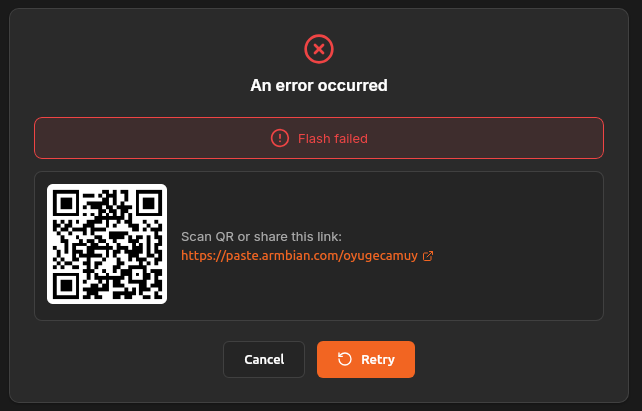
I have a Orange Pi Zero 2W and want to install a headless ( minimal ) OS. I have tried Armbian 25.5.1. I have an Ubuntu box and I have attempted to write to the SD card using Armbian ImagerImager, by selecting an image from the app as well as downloading an image to use. In both instances, I get a FLASH failure. See the attached image for the diag link. Can anyone give me some insight?
-
Efforts to develop firmware for H96 MAX M9 RK3576 TV Box 8G/128G
Werner replied to Hqnicolas's topic in Rockchip CPU Boxes
standard baud rate for rockchip socs is 1500000. And for the other your cp2102 is no good for this high speed since it cannot handle it. And instead of failing it will output garbage. get ft232r, cp2104 or pl2303 based adapter.