




robertoj
Members
-
Joined
-
Last visited
Everything posted by robertoj
-
I use the Linux official DRM enabled kernel module for ili9341... everybody has this KO... look for it in: roberto@orangepizero3:~/ads7846$ lsmod|grep ili ili9341 12288 0 panel_ilitek_ili9341 16384 0 drm_mipi_dbi 24576 2 ili9341,panel_ilitek_ili9341 roberto@orangepizero3:~/ads7846$ ls /lib/modules/6.6.31-current-sunxi64/kernel/drivers/gpu/drm/tiny/ gm12u320.ko ili9163.ko ili9341.ko mi0283qt.ko repaper.ko st7586.ko hx8357d.ko ili9225.ko ili9486.ko panel-mipi-dbi.ko simpledrm.ko st7735r.ko
-
-
FOR ORANGE PI ZERO 3: This is the version of the LCD DTS, to use NO CS and all pins in the lower end of the connector: ili9341-spi1-opiz3.dts ^ confirmed working in Orange Pi Zero 3, Linux 6.6.31, with drivers included in Armbian 24.8.0-trunk.21 bookworm v My current ATTEMPT to make the touch screen work: ads7846-opiz3-spi-gpio.dts It is not working... the errors may be visible here: More tests: It looks like PC7 is not available for IRQ GPIO due to SPI2... That was unexpected... I will try other pins Does the opiz3 even have a SPI2???
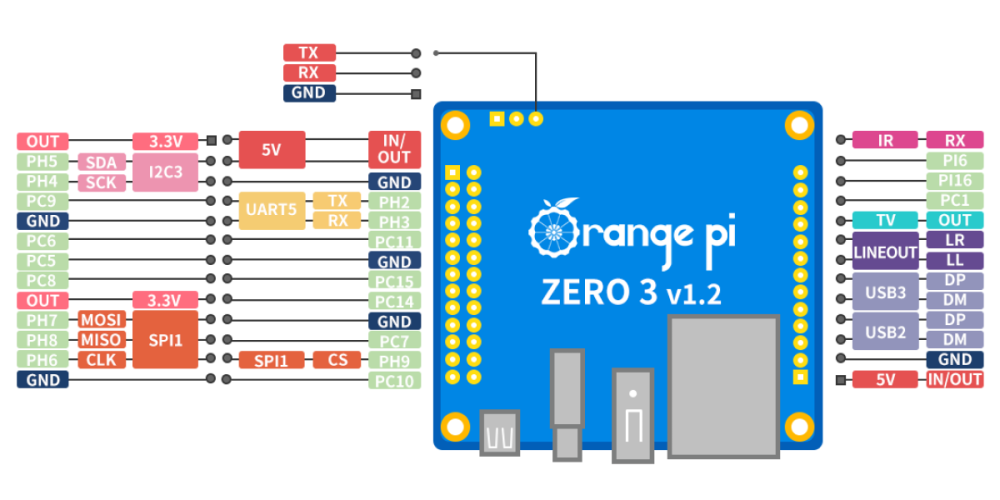
-
FOR ORANGE PI ZERO: This is the version of the LCD DTS, to use NO CS and all pins in the lower end of the connector: ili9341-spi1-opiz.dts To make the touch screen work, use this DTS: ads7846-opiz-spi-gpio.dts Confirmed to work in orange pi zero Linux 6.6.44 Wiring schematic later... but they are defined in the code comments
-
-
-
I have 2 of those ili9341+ads7846 LCDs and I already made them work with the banana pi m2 zero and the orange pi zero I needed to use spi-gpio, because I couldn't make both SPI chips work in the same bus. The ili9341 driver is in the Armbian distro, but needs a DTS to let the kernel know that the device is connected to those pins (see my thread about ili9341) The spi-gpio.ko needs to be built by the user. That DTS mentioned above that seems to use 1 bus for 2 SPI devices... so I ask about an actual report whether is works or not. Also: In my experience with bpi m2 zero and opiz, I can't figure out how to make the backlight control work, so the LED signal is connected to 3.3V... so I ask about that DTS: does it work?
-
I recently used Linphone for an audio call from my laptop to my desktop and it works for audio calls in command line mode With video calls, it is promising, but it complains with MSvp8 media errors (most likely can't use decoding libraries) I really want to use them in my armbian SBC since it is so lightweight (and my ili9341 LCD would look nice with a video call ) Does anyone here have experience with Linphone and BareSIP (another SIP video client, even more lightweight). The only discussion I see about it is in the Linphone google group and the german forum for "DoorPi"... but I can't see a guide to install and use it.
-
-
-
Document everything in your DTS, including how you calculate the GPIO numbers and the describe the physical wiring Make sure you use armbian-add-overlay correctly, and armbianEnv.txt doesn't include previous dtbo experiments. Send a schematic of your touch chip pins and your ARM board This is a reference on how it is done with an Allwinner H3 and spi-gpio. https://forum.armbian.com/topic/27457-connecting-banana-pi-m2-zero-with-ili9341-display-over-spi-on-latest-armbian-image/?do=findComment&comment=202734 Try changing the active-high/active low/edge up/edge down parameters
-
When the chip select is not specified, as above, the gpio pin is available for other uses I read somewhere that the ili9341 does not need the MISO wire because no information is read from the LCD ever... is this true? Some people are getting away with it https://forums.raspberrypi.com/viewtopic.php?t=370089 Also, if a wire is loose momentarily, the LCD locks up or turns "white-washed"... is there a way to reset the LCD and its KO module?
-
Are you a linux beginner also? Have you operated linux computers through SSH? What is your objective with an SBC? Desktop, server, media player, robot controller? This is the best guide around: https://github.com/robertojguerra/orangepi-zero-full-setup Keep in mind that following guides made years ago may not be valid anymore, and you need to research how to make it work Community suppport means: you ask questions in the forum, and someone who had the experience answers it
-
Can you get the gt911_btt_tft43_dip.dtbo source file DTS? I think there's a thread that explains how to decompile a DTBO into a DTS. In the DTS, you will find the exact kernel module needed. If you don't have it in /lib/kernel/6.xxx/kernel/drivers, you need to build an armbian image, and extract the KOs needed (look in the raspberry, run lsmod) Check out these threads: https://forum.armbian.com/topic/44191-orangepi-zero-lts-ili9341-tft-lcd-and-later-orangepi-zero-3/ https://forum.armbian.com/topic/27457-connecting-banana-pi-m2-zero-with-ili9341-display-over-spi-on-latest-armbian-image/page/2/#comments There's discussion about the thought process of making your DTS and there's a big difference between SPI and DSI... you should find examples of OTHER DSI screens I dont know why Raspberry OS uses KO parameter in the config.txt (equivalent to armbianEnv.txt), but more commonly, these parameters are passed in the DTS (creating a DTBO) Well, I see that the DTS is available, and it only refers to the touch part of the screen You will need to see how the raspberry community has made the screen work, and modify the DTS for your SBC https://forums.raspberrypi.com/viewtopic.php?t=315337
-
it is possible to install octoprint in a more powerful ARM (32bit) SBC, then move the project folder with its VENV folder, to a smaller ARM (32bit) SBC, fix something and then run it https://dev.to/geekypandey/copy-venv-from-one-folder-to-another-and-still-be-able-to-use-it-3m49 https://www.youtube.com/watch?v=iZlgLrWed1I
-
Thank you for your work The concept sounds super useful to me... I will try it
-
Did you try: apt update apt-cache search rear
-
Usually it means that you need to install a *-dev package apt-cache search ffmpeg-dev ... or try other key words Also make sure you have installed build-common and python3-dev If you cant install with pip, is it available in debian? apt-cache search python3 |grep ffmpeg
-
Hello, I am having a lot of fun making my first apps with python and tkinter... and with my recent good experiences with LCD TFT displays, I want to create an "appliance" project. I can start non-GUI apps with systemctl service files, and they run with the proper user permissions... and I don't worry about giving it root access. But I would like to do the same with GUI apps. They would be full screen, 320x240 on the LCD TFT. All I can do now is: * start with armbian minimal (with orange pi zero in my case) * add the DTS for LCD and touch, and the ko for spi-gpio (as seen in my threads in the orangepi zero section) * install the bare minimum for X11: xorg, xorg-video-fbdev, xorg-input-evdev, python3-tk, openbox, xterm * create an auxiliary starter script: launch_my_app.sh #!/bin/sh openbox --startup 'python3 /home/roberto/tkinter_test/tktest.py' Then, I execute from within my python project folder, in an ssh session as my username DISPLAY=:0.0 sudo startx ./launch_my_app.sh Then my tkinter app runs, until I press ctrl-C in the ssh. But I feel that sudo is unnecessary and too much for a cybersecurity perspective. Is there a way to make it start automatically? (it would be ideal if xorg would exit if the window is closed) Sample python code. Credits: https://www.pythonguis.com/tutorials/create-gui-tkinter/
-
-
It turned out that my USB power cable was too long... I replaced it with the previous short one and I am back in business. I am experimenting with NOT USING CS. Good progress: In the DTS, comment out with "/*" the line cs-gpios = <&pio 0 13 0>; /* PA13 chip select */ Also, change this line num-chipselects = <1>; to <0> Previous result of: sudo cat /sys/kernel/debug/pinctrl/1c20800.pinctrl/pinmux-pins ... New result, with NO CS configuration: ... ... ^ with my next steps, I hope to verify that PA13 is available for other things It plays an h264 file with no hiccups mplayer -vo fbdev2:/dev/fb0 mj_remember_time.mp4
-
-
-
-
For anyone interested in connecting the ili9341 to an orange pi zero, and use the adafruit DRM driver: ili9341-spi1-drm.dts I made these experiments, since the LCD is the only one chip in the SPI bus. * disconnect the LCD's Chip Select -> LCD remains white * connect the LCD's Chip Select to GND -> LCD displays the login line and linux crashes soon after <- it might be my orange pi zero, which needs a heatsink Update: this thread also refers to orange pi zero 3... the solution (with touch function) is in this post: https://forum.armbian.com/topic/44191-orangepi-zero-lts-ili9341-tft-lcd-and-later-orangepi-zero-3/#findComment-204672
