Active threads
Showing topics posted in for the last 365 days.
- Today
-
Worth trying all of them.
-

networking in bpi-m5 with new 26.03.1 release.
eselarm replied to gene1934's topic in Software, Applications, Userspace
You mix up 2 things: - 'msdos filesystem' which usually means 'FAT' - 'msdos table' which usually means 'MBR partition table' Both can be up to 2 TeraBytes when sector or cluster size is 512 bytes. So no reason to change to GPT. Changing to GPT (with standard 128 entries), will use the same space as where the U-Boot bootloader is located on SD-card for older Arm chips, like Allwinner A20 (original bananapi). So risk is un-bootable. Back to your networking issues: I have not read all, but this BPI-M5 image is Ubuntu based and I see NetworkManager. So that means you also get netplan. I don't want that, so I only use Debian based images as a start. But it seems that if you use 'nmtui' text based tool that you still can quite easily set fixed IP addresses locally. At least that is the case for 'Raspberry Pi OS Trixie' where they also made a dependency between netplan and NetworkManager. Then since this year also Debian by default uses systemd-resolved for their pre-installed (cloud) images for DNS. This means it all won't work out of the box for you. Same was the case for me, I use also my own router and DNS server and that did not work with Armbian (half a year ago). I think now some extra is done, as tests with 26.2 images what Igor asked for, worked OK, but only did boot them via serial console. Look up the forum topic about it if you want to know, I already forgot. So to work with local hosts file on every computer, the whole Linux must prioritize hosts file over DNS resolver. That is determined in /etc/nsswitch.conf I have at least 2 ARM64 computers that need fixed IP (they must work without router) so I have a few entries in hosts file, very limited and dedicated, as rest is all in router. So what I do with new images when some tests or so, is (as root): systemctl disable --now systemd-resolved # this stops the DNS resolver and also makes sure it won't start after reboot rm /etc/resolv.conf # when systemd-resolved is used, this file is a symbolic link to tmpfs in RAM, so if not removed, your next settings are lost after reboot echo nameserver 192.168.71.1 > /etc/resolv.conf Then same as on older (bookworm) Raspberry Pi OS, install openresolv (it handles access to /etc/resolv.conf 😞 apt install openresolv I can not guarantee that it all works the same in Ubuntu when netplan is active, but up to you to figure that out yourself in your network environment. -

[Latest] Armbian Build HDMI Audio support Fix
MarkAntony replied to just_facking_about's topic in Radxa Dragon Q6A
@rsbuffalo's Feb 18th post worked a treat for me on my Dragon Q6a (Armbian 26.2.1 trixie, xfce 4.20). Thanks so much for sharing your solution. - Yesterday
-
 @HenricoLegal can you find the wifi chip on your board?
 -
Holy Shit this is great! Finally can get use out of this doorstopper if you continue. Imagine getting MeshCore or Meshtastic installed.
-
Nicely done. As some additional thoughts: 1. Fragment 0 and 2 of your .dts point to the same spot. They could be combined if you'd like. 2. The util-linux-extra package should be part of the core Ubuntu distribution. An apt install should have been enough, though you may need to enable the universe repository. 3. If you have a /dev/rtc1 device, that suggests that you have an rtc0 as well, and if you disable it, the kernel will natively load and store time to the one you provided. A quick glance at the .dts suggests one at /soc/bus@ff800000/rtc@a8. Adding one final fragment to your overlay like the below might allow you to skip need of hwclock, and both SystemD services for your RTC. See my note about CONFIG_RTC_HCTOSYS_DEVICE and CONFIG_RTC_SYSTOHC_DEVICE above. fragment@3 { target-path = "/soc/bus@ff800000/rtc@a8"; __overlay__ { status = "disabled"; }; }; 4. If you're up for it, submit a PR to create a dtbo for the I2C buses on the M5? Contributions to the project are always welcome.
-
 @Nick A Thank you, can you publish a server image for the Radxa A7Z with kernel 6.18?
 -
If an pre-made image is not there, just DIY. https://docs.armbian.com/Developer-Guide_Build-Preparation/
-
I see. Well I can confirm my bootloader is very stable. I have been running it on two devices for a couple years now without any issues. It cannot hurt to flash it again (to rule out random bitflips), but if you are getting sporadic crashing no matter the kernel/OS it does start to indicate a hardware issue. I have a laptop that crashes sporadically but it isn't so bad that I cannot use it. I've run memtest on it countless times without issue, tried replacing RAM, etc. some devices really are just cursed for whatever reason unfortunately. In case it is helpful, you can find the config for the kernel I run on my devices here: https://github.com/bschnei/linux-a3700
- Last week
-
Tried building a trixie image with this tee and still locks at the same spot
-
ok. I have 5 cubieboard 1. Not possible memory card for every one.
-
Great! I will start to tinker around with armbian.
-

Games Compatible With Armbian on Pinebook Pro
LivingLinux replied to Katsujinken's topic in Pinebook Pro
My PBP died, so I can no longer test it myself. You can start by testing the PPSSPP aarch64 AppImage. https://github.com/hrydgard/ppsspp/releases A couple of years ago I had performance issues with the PPSSPP Flatpak on my Phytium D2000, so I built it on Ubuntu 22.04. I'm not sure if I followed the instructions for Qt, or for Linux. So you need to install the prerequisites and I guess it doesn't hurt to install the additional packages mentioned for Ubuntu. https://github.com/hrydgard/ppsspp/wiki/build-instructions#building-with-cmake-other-platforms-eg-linux -

Teclast T60 AI rooting + armbian possibility Allwinner A733
Werner replied to Taz's topic in Allwinner CPU Boxes
moved to tvboxes -
Hi @BOFFBOY, have you managed to make it work? Having similar issue : tried with two different orange pi 5 , two different nvme SSDs, three different Power supplies up to 5V/5A and three armbian kernels: 5.10 | 6.1 and 6.18
-
Okay I think you are right they are shifting the RAM GB numbers so 8 GB is actually 4 GB as the price suggests. Now now, what I ended up doing is I bought a Teclast T60 AI tablet(for 100 euro shipped in EU) with Allwinner A772 which is supported by armbian and comes with 6GB RAM. I do not know if I will be trying to boot armbian on it soon but I was able to root it with Magisk. It did went on quite a journey to get it rooted as I kind of soft bricked it at first. Deepseek was giving me little wrong information but we got there. I think I might need a more competent AI agent like Gemini pro to get display, touch, wifi, bluetooth etc. working with armbian. Perhaps I post about the rooting process elsewhere at some point. Here is some of the gear I have if people are interested: https://www.aliexpress.com/item/1005009330391341.html DUX DUCIS Foldable Bluetooth 5.0 Keyboard with Touchpad & Phone Holder For Phones Tablets PC iOS Android Windows Mac https://www.aliexpress.com/item/1005011827691576.html https://www.aliexpress.com/item/1005009419399930.html HGFRTEE 3840*2160 13.3inch 4K Portable Monitor All in all pretty pleased with it so far, not exactly Surface pro 5/7 which I also have and they all weight about 1000 grams but then on the other hand this tablet did not cost me hundreds of $ so I can be little less nervous about someone stealing it.
-

CSC Armbian for RK3318/RK3328 TV box boards
andrey.lobov replied to jock's topic in Rockchip CPU Boxes
@jock Thank you, I will try. -
After more than six successful years with Helios4, I have to say goodbye to this platform and the highly valued, helpful, and knowledgeable Armbian forum. With 32-bit, it’s no longer feasible to continue using it in the future. I have installed the 4 8TB hard drives from the NAS into an Odroid H4+ (Intel, 64-bit), installed OMV8, and on top of that, Nextcloud-AIO Hub 26 Winter and AdGuardHome. Thank you very much for your support over the past few years. btw. The Helios4 hardware (excluding the hard drives) is still available.
-
 Hi.. I need de original firmware for android box Q17 Allwinner h313.. Someone can help me?
 -
I'd like to add my observations. The current version is 7.0.0-rc6-edge-sunxi64. The wireless interface is available, but if Ethernet is connected, it's impossible to connect to either interface via SSH. However, as soon as the Ethernet speed is set to 100, both interfaces become operational. Maybe this will help revive the hardware.
-
Hi Iuri, I had a similar issue for the rock3a, but I'm using a BigTreeTech 5" DSI display for use on a 3d printer. I've been dabbling in device drivers for 3 years with limited success, but I can say I recently got the 5" dsi display to work. All of my work is here: https://github.com/saltydog101/rock3a_dsi I had to load a new kernel module and then I was able to create a working dtbo for it. It was definitely more than I expected. That being said, when a vendor like Rockchip, Radxa or BigTreeTech decided to make a modification to the linux kernel and not have it committed to mainline, I don't think this is Armbian's issue at all. The engineers and community here do amazing work getting linux running on so many devices. You would normally have better luck looking at Radxa's discord and/or their documentation.
-
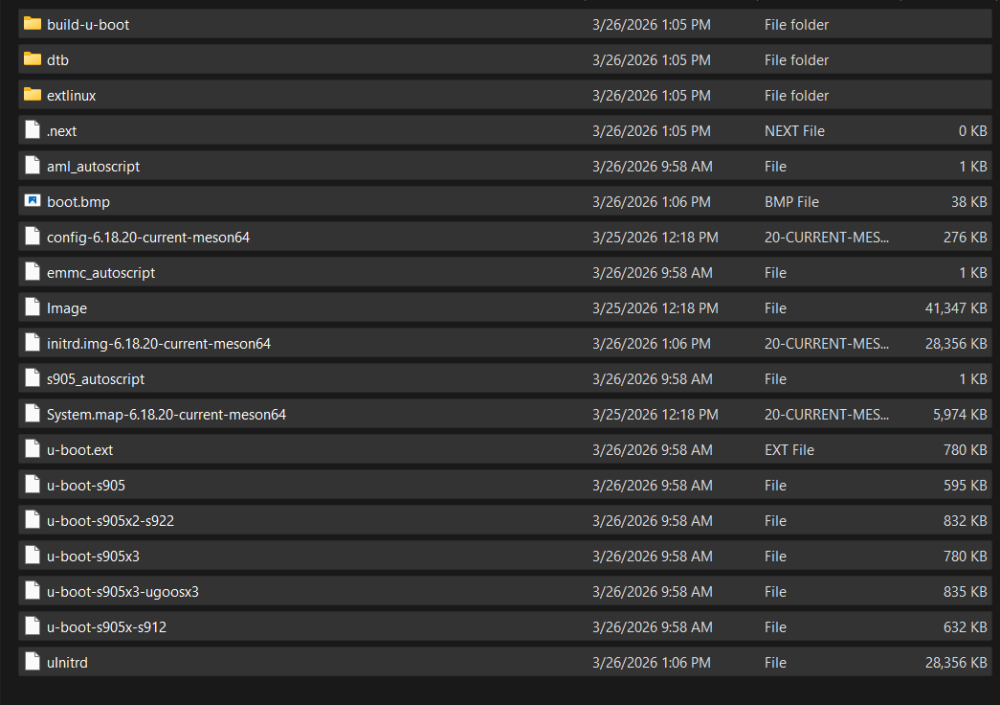
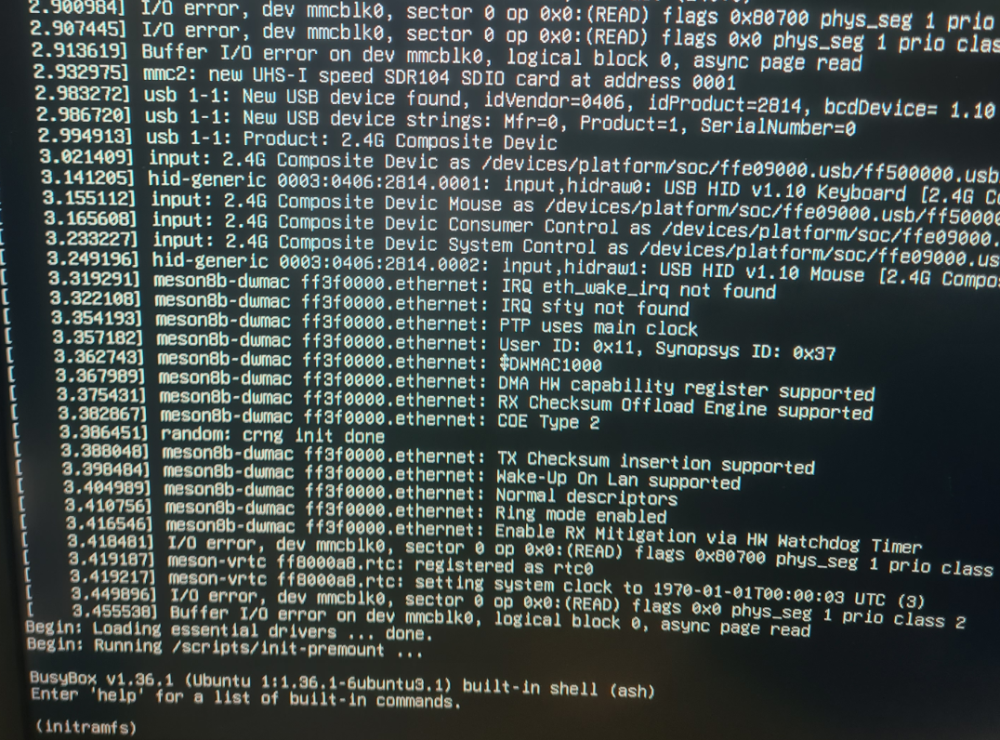
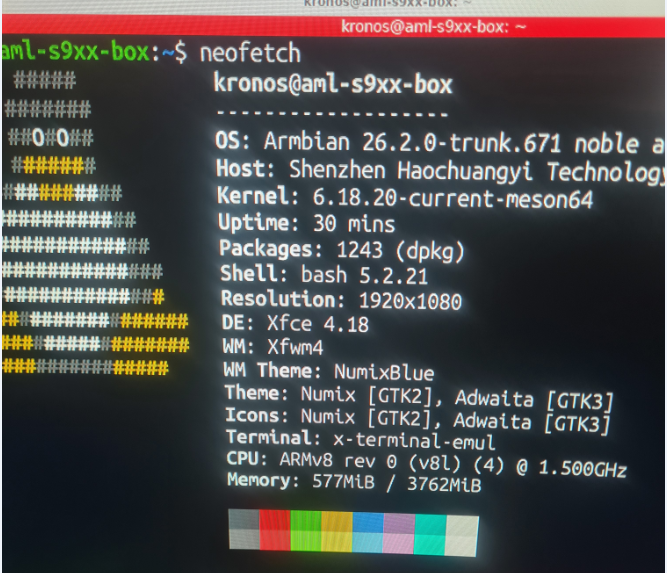
i will get that information for you.Sorry i did not give it sooner Box: H96 model x3 cpu-s905x3 rom 64gb the config file is kernel /Image initrd /uInitrd fdt /dtb/amlogic/meson-sm1-h96-max.dtb append root=UUID=54072e2a-0ddf-4b60-930c-f13cc5fc51b1 rootflags=data=writeback console=ttyAML0,115200n8 console=tty0 rw no_console_suspend consoleblank=0 fsck.fix=yes fsck.repair=yes net.ifnames=0 splash plymouth.ignore-serial-consoles I will post a neofetch of the usb flash that armibian works from on the same box strange enough when i take the sd card out the port on the box and place it in a usb card reader then boot armbian boots up ok and works(except the wifi) WHen i place the sd card back into the slot i get no errors but get stuck on initram
-
 Collabora presents "Bringing BitNet to ExecuTorch via Vulkan" at PyTorch Conference Europe in Paris (April 7-8) and attends ICLR in Rio de Janeiro (April 23-27). Connect with our team to discuss machine learning and open source innovation! View the full article
 -
Open source projects like ours operate with very limited resources, and infrastructure such as mirrors is maintained on a best-effort basis. We’re aware that things are not always perfect, but addressing this properly requires dedicated maintainers - something we never had. If you’d like to help improve the situation, we’d genuinely welcome someone stepping in to take ownership of this part of the infrastructure. Improving scripts to make this information correct and other things that are missing ... Perhaps contanting mirror owner would already be a solution. I understand - but our mirror system isn’t a standard Debian-style setup. The “empty mirrors” you’re seeing are a cosmetic problem. Only status isn’t automatically pruned yet, so entries can remain listed after they’re no longer active. This does not affect users: traffic is routed through apt.armbian.com and dl.armbian.com, which only serve from working mirrors. What’s missing is automation to keep the public listing in sync - not mirror functionality itself. One of those https://actions.armbian.com/?repo=armbian.github.io needs further development. Our rsync server works: rsync -av rsync://rsync.armbian.com/dl/ I have no clue as this mirror is not under our direct control. Edit: I sent email to administrator of AARNet.
-
@Octavio Cuatrochio I just noticed your link in the first post. The board in the link is a FAKE Allwinner H313. If your board does not have a small AXP### chip then it's not an Allwinner H313.