All Activity
- Today
-
I managed to disable heartbeat. I am running HA based on debian trixie and my it was only led i could change to off echo none |sudo tee /sys/class/leds/mmc1\:\:/trigger
-
I can't install mpd on Armbian v26.2 rolling for NanoPi Air running Armbian Linux 6.12.76-current-sunxi Packages: Ubuntu stable (noble) user@nanopiair:~$ sudo apt install mpd Reading package lists... Done Building dependency tree... Done Reading state information... Done Some packages could not be installed. This may mean that you have requested an impossible situation or if you are using the unstable distribution that some required packages have not yet been created or been moved out of Incoming. The following information may help to resolve the situation: The following packages have unmet dependencies: mpd : Depends: libavcodec61 (>= 7:7.0) but it is not installable Depends: libavfilter10 (>= 7:7.0) but it is not installable Depends: libavformat61 (>= 7:7.0) but it is not installable Depends: libavutil59 (>= 7:7.0) but it is not installable Depends: libflac14 (>= 1.5.0) but it is not installable Depends: libfmt10 (>= 10.1.1+ds1) but it is not installable Depends: libicu76 (>= 76.1-1~) but it is not installable Depends: libiso9660-12 (>= 2.2.0) but it is not installable Depends: libsidplayfp6 (>= 2.12.0) but it is not going to be installed Depends: libjs-sphinxdoc (>= 8.1) but it is not going to be installed Depends: sphinx-rtd-theme-common (>= 3.0.2+dfsg) but it is not going to be installed E: Unable to correct problems, you have held broken packages. What is the issue with missing packages ?
-

Vontar KK MAX / HK1 RBOX R2 / R3 - RK3566 4GB/32GB(or 64GB)
Deoptim replied to Deoptim's topic in Rockchip CPU Boxes
Continuing to dig into this. Updated the Armbian images - available via the same links above (md5sum mismatch): How to add the module to an already working system (so you don't have to reinstall from scratch): 1. Download the archive ws2801-1.0.tar.gz with the dkms source code for the ws2801 module. 2. Extract the source folder to /usr/src/ : sudo tar -xzvf ~/ws2801-1.0.tar.gz -C /usr/src/ (here ~/ is the /home directory of my user) 3. Install the module step-by-step via dkms: sudo dkms add ws2801/1.0 sudo dkms build ws2801/1.0 sudo dkms install ws2801/1.0 4. To avoid rebooting, you can load the module immediately: sudo modprobe ws2801 By default, Red should start blinking as a "heartbeat" trigger. Description of dts and demo: -
- Yesterday
-

NanoPi Neo2 V1.1 / how to control OTG port power with GPIO 354?
mdrmdr replied to mdrmdr's topic in Allwinner sunxi
A long time ago, that I started the question, but a few days ago, I started again to solve it. And with the help of several AI, I found a working solution. This is the working overlay: /dts-v1/; /plugin/; /* * NanoPI Neo2 H5 - OTG USB with switchable VBUS * Allows SD-Card as USB device on OTG port with GPIO-controlled power * * Key points: * - fragment 0: dr_mode "otg" enables dual-role (host+device detection) * - fragment 1: Removing usb0_id_det-gpios prevents "External vbus detected" error * - fragment 2: Removing gpio property from regulator keeps GPIO 354 (PR2) free for manual control * - fragment 3: GPIO 354 is controlled via usb.sh script (echo 1/0 to /sys/class/gpio/gpio354/value) * * GPIO 354 (PR2) state: * 1 = VBUS ON (USB device recognized) * 0 = VBUS OFF (USB device disconnected) */ / { compatible = "allwinner,sun50i-h5"; fragment@0 { target = <&usb_otg>; __overlay__ { dr_mode = "otg"; status = "okay"; }; }; fragment@1 { target = <&usbphy>; __overlay__ { usb0_id_det-gpios; }; }; fragment@2 { target-path = "/usb0-vbus"; __overlay__ { gpio; status = "okay"; }; }; fragment@3 { target = <&r_pio>; __overlay__ { usb0_vbus_pin: usb0_vbus_pin { pins = "PR2"; function = "gpio_out"; output-high; }; }; }; }; This allows the standard GPIO controls using sysfs in /sys/class/gpio. I'm using the kernel Linux nanopineo2 6.6.75-current-sunxi64 on Armbian 25.11.2 bookworm (32 bit userland). Hope this helps everybody trying to achive the same 😉 -
Added the respective PR: https://github.com/armbian/build/pull/9496
-

How to use OrangePi 5 Plus's NPU for Image Generation?
usual user replied to Johson's topic in Beginners
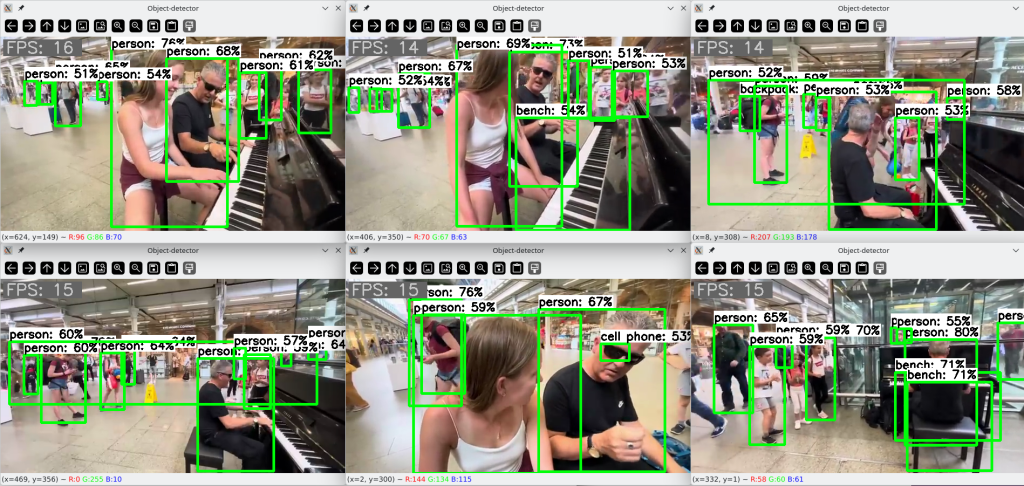
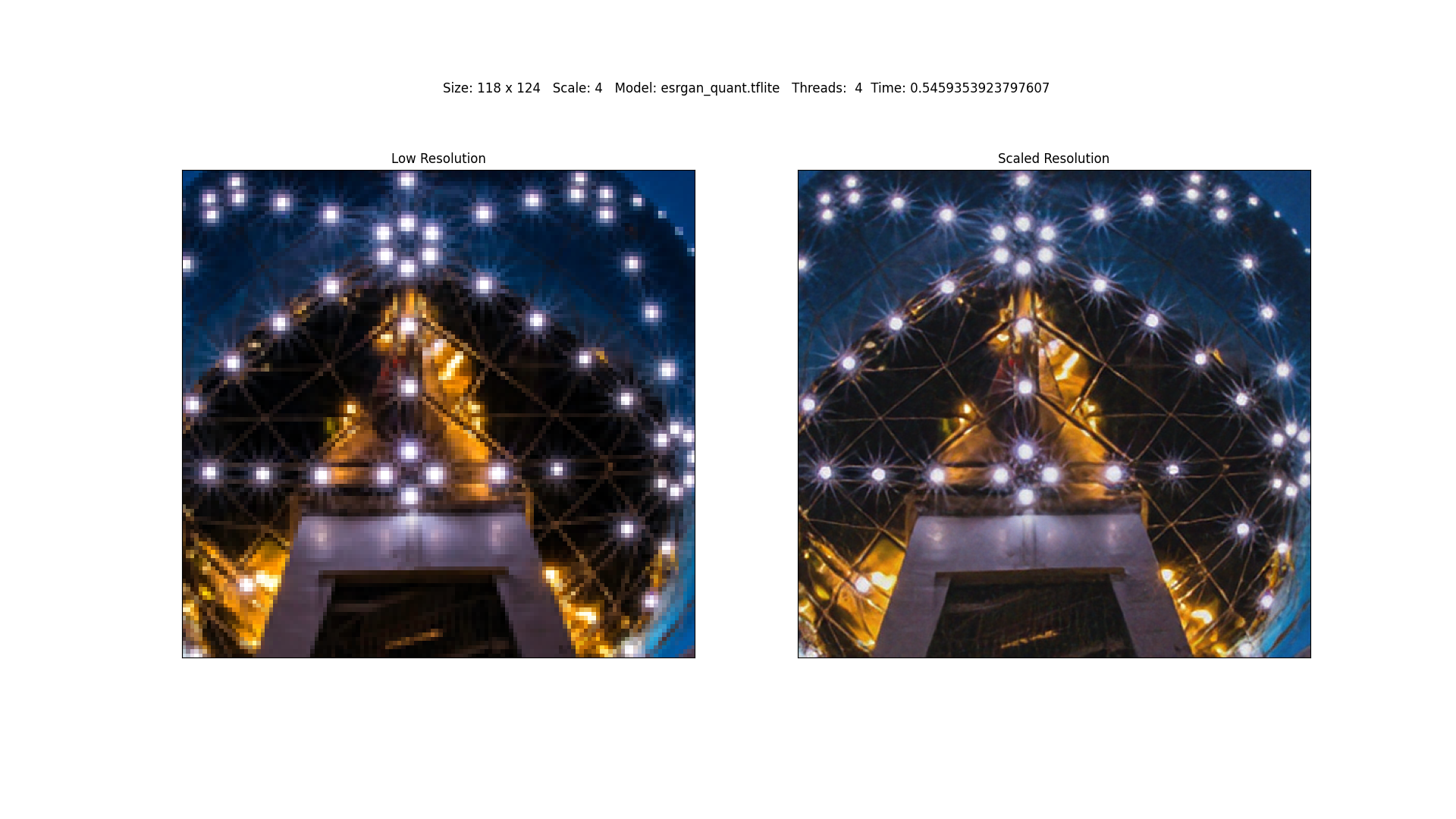
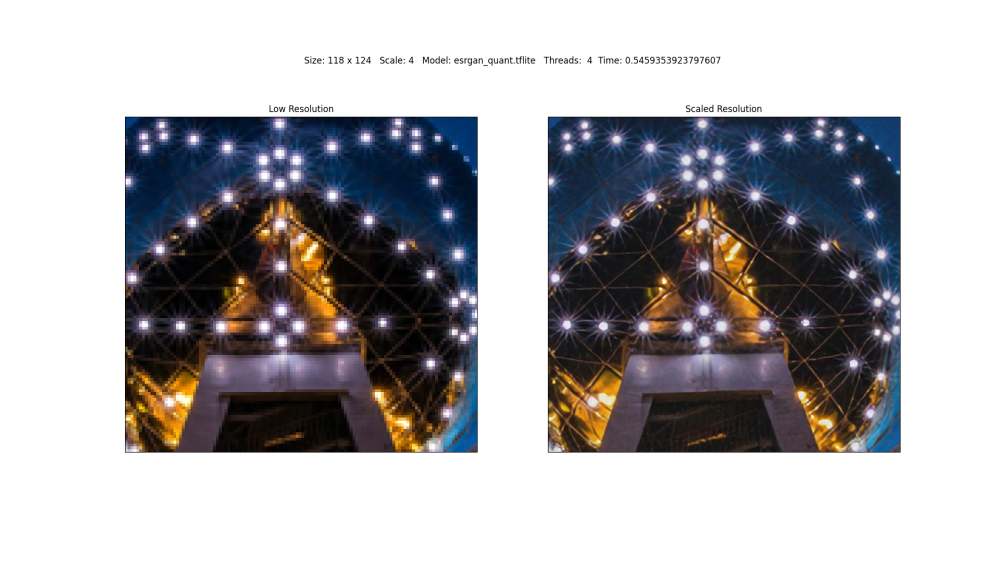
Since the hardware support for Rockchip SoCs in the mainline kernelis generally already very outstanding and their further development is also being actively pursued, I only have SBCs with integrated NPUs that are based on them. Among them are ODROID-M2, NanoPC-T6, and ROCK-5-ITX. But since the NPU is an integral part of the SoC, the board manufacturer and the design of the SBC are not necessarily of importance. As far as I understand, edge-class NPUs are best suited for computer vision tasks. I am therefore engaged in object detection: and super-resolution: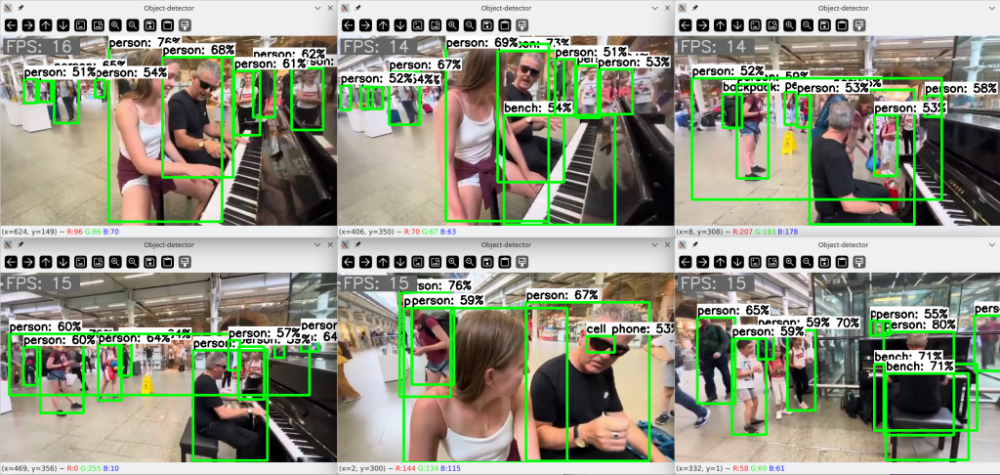
-
I'm having a problem with my Raspberry Pi 5, which I describe below. I have a DVR connected to it via Ethernet. If I connect both at the same time, dmesg reports a failure and I can't ping the DVR to establish a connection; I have to run `ifconfig eth0 down` and `ifconfig eth0 up`. Can anyone help or know if there's a bug in the kernel version? I'm using Ubuntu 22.04. jammy root:~# dmesg | grep eth0 [ 1.312167] macb 1f00100000.ethernet eth0: Cadence GEM rev 0x00070109 at 0x1f00100000 irq 108 (2c:cf:67:81:d6:2a) [ 3.237493] systemd[1]: Found device /sys/subsystem/net/devices/eth0. [ 3.453483] systemd[1]: Started ifup for eth0. [ 3.573655] macb 1f00100000.ethernet eth0: PHY [1f00100000.ethernet-ffffffff:01] driver [Broadcom BCM54213PE] (irq=POLL) [ 3.573668] macb 1f00100000.ethernet eth0: configuring for phy/rgmii-id link mode [ 6.441950] macb 1f00100000.ethernet eth0: Link is Up - 100Mbps/Full - flow control off [ 11.560707] macb 1f00100000.ethernet eth0: Link is Down [ 13.605678] macb 1f00100000.ethernet eth0: Link is Up - 100Mbps/Full - flow control off root:~# ping 192.168.200.201 PING 192.168.200.201 (192.168.200.201) 56(84) bytes of data. ^C --- 192.168.200.201 ping statistics --- 6 packets transmitted, 0 received, 100% packet loss, time 13305ms root:~# ifconfig eth0 down root:~# ifconfig eth0 up root:~# dmesg | grep eth0 [ 1.312167] macb 1f00100000.ethernet eth0: Cadence GEM rev 0x00070109 at 0x1f00100000 irq 108 (2c:cf:67:81:d6:2a) [ 3.237493] systemd[1]: Found device /sys/subsystem/net/devices/eth0. [ 3.453483] systemd[1]: Started ifup for eth0. [ 3.573655] macb 1f00100000.ethernet eth0: PHY [1f00100000.ethernet-ffffffff:01] driver [Broadcom BCM54213PE] (irq=POLL) [ 3.573668] macb 1f00100000.ethernet eth0: configuring for phy/rgmii-id link mode [ 6.441950] macb 1f00100000.ethernet eth0: Link is Up - 100Mbps/Full - flow control off [ 11.560707] macb 1f00100000.ethernet eth0: Link is Down [ 13.605678] macb 1f00100000.ethernet eth0: Link is Up - 100Mbps/Full - flow control off [ 147.034711] macb 1f00100000.ethernet eth0: Link is Down [ 151.855860] macb 1f00100000.ethernet eth0: PHY [1f00100000.ethernet-ffffffff:01] driver [Broadcom BCM54213PE] (irq=POLL) [ 151.855871] macb 1f00100000.ethernet eth0: configuring for phy/rgmii-id link mode [ 152.869842] macb 1f00100000.ethernet eth0: Link is Up - 100Mbps/Full - flow control off root:~# ping 192.168.200.201 PING 192.168.200.201 (192.168.200.201) 56(84) bytes of data. 64 bytes from 192.168.200.201: icmp_seq=1 ttl=64 time=1.01 ms 64 bytes from 192.168.200.201: icmp_seq=2 ttl=64 time=1.01 ms ^C --- 192.168.200.201 ping statistics --- 2 packets transmitted, 2 received, 0% packet loss, time 1001ms rtt min/avg/max/mdev = 1.007/1.007/1.007/0.000 ms
-
On RK3568 the Panfrost driver needs the clk-scmi kernel module to be loaded. But is not build in 6.18 / 6.19 otherwise we get [ 13.370681] panfrost fde60000.gpu: get clock failed -517 [ 13.370717] panfrost fde60000.gpu: clk init failed -517 [ 13.485723] panfrost fde60000.gpu: get clock failed -517 [ 13.485761] panfrost fde60000.gpu: clk init failed -517 [ 13.503876] panfrost fde60000.gpu: get clock failed -517 [ 13.503918] panfrost fde60000.gpu: clk init failed -517 Thanks !
-
It not works for me. I followed the official document to flash the SPI: https://docs.radxa.com/en/cubie/a5e/getting-started/install-system/nvme-system/burn-spi However after I wrote the latest Armbian img into NVMe disk, it failed to boot: [132]HELLO! BOOT0 is starting! [135]BOOT0 commit : 33d8db429a-dirty [140]periph0 has been enabled [143]set pll end [145]PL gpio voltage : 3.3V [149]PMU: AXP2202 [154]PMU: AXP1530 [159]power mode:33, sys_vol:920 [164]vaild para:1 select dram para0 [167]dram_para[0]:0x4b0 [170]dram_para[1]:0x8 [172]dram_para[2]:0x7070707 [175]dram_para[3]:0xd0d0d0d [178]dram_para[4]:0xe0e [181]dram_para[5]:0x84848484 [184]dram_para[6]:0x310a [186]dram_para[7]:0x10001000 [189]dram_para[8]:0x0 [192]dram_para[9]:0x34 [194]dram_para[10]:0x1b [197]dram_para[11]:0x33 [199]dram_para[12]:0x3 [202]dram_para[13]:0x0 [204]dram_para[14]:0x0 [207]dram_para[15]:0x4 [209]dram_para[16]:0x72 [212]dram_para[17]:0x0 [214]dram_para[18]:0xe [216]dram_para[19]:0x0 [219]dram_para[20]:0x0 [221]dram_para[21]:0x26 [224]dram_para[22]:0x80808080 [227]dram_para[23]:0x6060606 [230]dram_para[24]:0x1f0b0503 [233]dram_para[25]:0x0 [236]dram_para[26]:0x3a000000 [239]dram_para[27]:0x802f3333 [242]dram_para[28]:0xc0c0bbbf [245]dram_para[29]:0x35352f31 [248]dram_para[30]:0xc64 [251]dram_para[31]:0x48484848 [254]board init ok [277]enable_jtag [279]boot param - This media is not supported [283]boot param - Media not supportedsunxi_bootparam_cpu_read...91 [290]boot param - magic error [293]DRAM BOOT DRIVE INFO: V0.67 [297]DRAM_VCC set to 1100 mv [424]DRAM retraining ten [550]DRAM retraining ten [567][AUTO DEBUG]32bit,1 ranks training success! [597]Soft Training Version: T2.0 [7728][SOFT TRAINING] CLK=1200M Stable memtest pass [7733]DRAM CLK =1200 MHZ [7736]DRAM Type =8 (3:DDR3,4:DDR4,7:LPDDR3,8:LPDDR4) [7747]phy_dfs_clk1 = 800M [8082]phy_dfs_clk2 = 400M [8176]phy_dfs_clk3 = 150M [8299]phy_dfs_clk0 = 1200M [8302]DRAM MDFS VERSION INFO: V0.660 [8306]DRAM MDFS time =39480 ns [8309]DRAM SIZE =2048 MBytes, para1 = 310a, para2 = 8000000, tpr13 = 6465 [8340]DRAM simple test OK. [8343]dram size =2048 [8350]nsi init 2023-2-23 [8353]spinor id is: ef 60 18, read cmd: 03 [8358]Succeed in reading toc file head. [8361]The size of toc is 1a0000. [8910]Entry_name = u-boot [8920]Entry_name = monitor [8924]Entry_name = scp [8928]Entry_name = dtb [8931]Jump to second Boot. NOTICE: BL31: OP-TEE 32bit detected NOTICE: BL31: U-BOOT 32bit detected NOTICE: BL31: v2.5(debug):a6e1826c1 NOTICE: BL31: Built : 10:10:43, Mar 28 2025 NOTICE: BL31: No DTB found. nsi init ok 2022-11-08 ERROR: Error initializing runtime service opteed_fast U-Boot 2018.07-9-boot-aw2501-g56bb8c6a2ea-dirty (Sep 16 2025 - 08:32:16 +0000) Allwinner Technology [09.082]CPU: Allwinner Family [09.085]Model: Radxa Cubie A5E I2C: ready [09.097]DRAM: 2 GiB [09.101]Relocation Offset is: 75e60000 [09.163]secure enable bit: 0 [09.166]PMU: AXP2202 [09.195][AXP2202] comm status : 0x0 = 0x20, 0x1 = 0x90 [09.200][AXP2202] onoff status: 0x20 = 0x4, 0x21 = 0x0 [09.205][AXP2202] reboot/charge status: 0xf0 = 0x0 [09.209]PMU: AXP1530 [09.212]CPU=1008 MHz,PLL6=600 Mhz,AHB=200 Mhz, APB1=100Mhz MBus=600Mhz [09.219]gic: sec monitor mode SPI ALL: ready [09.224]flash init start [09.226]workmode = 0,storage type = 3 [09.231]spi sunxi_slave->max_hz:50000000 SF: write offset not multiple of erase size [09.771]spi sample_mode:0 sample_delay:1f [09.776]spi sunxi_slave->max_hz:50000000 SF: Detected w25q128fw( ) with page size 256 Bytes, erase size 64 KiB, total 16 MiB [09.788]sunxi flash init ok [09.797]Loading Environment from SUNXI_FLASH... OK [09.803]No ethernet found. [09.805]Failed to found available display route [09.810]Get sunxi drm device fail! [09.813]get secure storage map err [09.816]sunxi secure storage is not supported [09.820]usb burn from boot delay time 0 weak:otg_phy_config [09.830]usb prepare ok [10.133]overtime [10.138]do_burn_from_boot usb : no usb exist SF: write offset not multiple of erase size [10.189]get secure storage map err [10.192]secure storage init fail cann't get the boot_base from the env [10.201]update part info [10.212]update bootcmd pcie link up success PCIe speed of Gen2 [10.524]change working_fdt 0xbbe0fe18 to 0xbbddfe18 [10.532]## error: update_fdt_dram_para_from_bootpara : FDT_ERR_NOTFOUND [10.538]Invalid phandle:0 [10.540]only find 1073741818 phandle, format:endpoints=<&disp0_out_tcon0 &tcon0_out_rgb0>; [10.549]Failed to found available display route [10.553]chip id : 0x0000ff10 0x00004824 0x0000c31c 0x000023da [10.559]chip id : 0x0000ff10 0x00004824 0x0000c31c 0x000023da [10.564]Could not find nodeoffset for used ext pmu:reg-axp1530 [10.570]update dts curr_device:-1 No MMC device available Hit any key to stop autoboot: 0 starting USB... USB0: start sunxi USB-DRD... config usb clk ok sunxi USB-DRD init ok... USB EHCI 1.00 scanning bus 0 for devices... 1 USB Device(s) found USB1: start sunxi USB1-Host... config usb clk ok sunxi USB1-Host init ok... USB EHCI 1.00 scanning bus 1 for devices... 1 USB Device(s) found scanning usb for storage devices... 0 Storage Device(s) found Device 0: device type unknown ... is now current device ** Bad device usb 0 ** ** Bad device usb 0 ** No MMC device available Scanning PCI devices on bus 1 BusDevFun VendorId DeviceId Device Class Sub-Class _____________________________________________________________ 01.00.00 0x1217 0x8760 Mass storage controller 0x08 Device 0: Vendor: 0x1217 Rev: 10100080 Prod: NB3925D000028 Type: Hard Disk Capacity: 58999.9 MB = 57.6 GB (120831998 x 512) ... is now current device Scanning nvme 0:1... Found U-Boot script /boot.scr 4641 bytes read in 2 ms (2.2 MiB/s) ## Executing script at 4fc00000 subfdt=sun55i-a527-cubie-a5e.dtb U-boot loaded from SD Boot script loaded from nvme 239 bytes read in 1 ms (233.4 KiB/s) sun55i-a527-cubie-a5e.dtb: No match Load fdt: /dtb/allwinner/sun55i-a527-cubie-a5e.dtb 37110 bytes read in 4 ms (8.8 MiB/s) 16547680 bytes read in 141 ms (111.9 MiB/s) 39950848 bytes read in 264 ms (144.3 MiB/s) ## Loading init Ramdisk from Legacy Image at 4ff00000 ... Image Name: uInitrd Image Type: AArch64 Linux RAMDisk Image (gzip compressed) Data Size: 16547616 Bytes = 15.8 MiB Load Address: 00000000 Entry Point: 00000000 Verifying Checksum ... OK No Linux ARM Ramdisk Image Ramdisk image is corrupt or invalid SCRIPT FAILED: continuing... No MMC device available No MMC device available No ethernet found. missing environment variable: pxeuuid missing environment variable: bootfile Retrieving file: pxelinux.cfg/00000000 No ethernet found. missing environment variable: bootfile Retrieving file: pxelinux.cfg/0000000 No ethernet found. missing environment variable: bootfile Retrieving file: pxelinux.cfg/000000 No ethernet found. missing environment variable: bootfile Retrieving file: pxelinux.cfg/00000 No ethernet found. missing environment variable: bootfile Retrieving file: pxelinux.cfg/0000 No ethernet found. missing environment variable: bootfile Retrieving file: pxelinux.cfg/000 No ethernet found. missing environment variable: bootfile Retrieving file: pxelinux.cfg/00 No ethernet found. missing environment variable: bootfile Retrieving file: pxelinux.cfg/0 No ethernet found. missing environment variable: bootfile Retrieving file: pxelinux.cfg/default-arm-sunxi No ethernet found. missing environment variable: bootfile Retrieving file: pxelinux.cfg/default-arm No ethernet found. missing environment variable: bootfile Retrieving file: pxelinux.cfg/default No ethernet found. Config file not found => The firmware filename I downloaded is: Armbian_community_26.2.0-trunk.493_Radxa-cubie-a5e_trixie_edge_6.18.13_minimal.img.xz
-
 nfs shares are now rudimentary implemented
 - Last week
-
use the images in this thread
-
 I started down this path and realized that the patches are applied to downloaded linux kernel source. Normally, the kernel source is "cleaned" even if the build fails. I then found the sakura pi github page and the page has more recent commit than the Rock-s0, incorporates the kernel.dtsi while adhering the the u-boot requirements for rockpi's. U-boot for Rockpi. I'd like to base my build on the more up-to-date code. The easist way to do this is set CLEAN_LEVEL="" but I'm running into issues with the patches in GitHub: Sakura-Pi failing to apply. Essentially, I would iike to have the patches apply, not necessarily build and have the files generated by the patches remain. I have a large dtb file, extracted from Sovol's OEM firmware, that I would like to copy/paste into the generated *.dtb file, rename the *csc file and the defconfig file, and then generate a patch against clean source. Conceptually, this should work and I'm suprised it is this difficult to generate a new board for an existing family. Alternatively, a script could generate a file from a highlited portion of a patch and generate a file. Or is is possbile to run ./compile.sh a step at a time? It would be helpful in this setting, very instructive about the process and would narrow down build failures. Am I on the right path? Any step-by-step examples and or links to helpful scripts?
 -
 As champions of open source development in the embedded community, Collabora will be at Booth 4-404 with an impressive lineup of live demonstrations spanning graphics, machine learning, continuous testing, and real-world applications. View the full article
 -
Hi, would this image work on x96q?
-
I have to be upfront: I'm not a developer. I'm an ops/observability engineer who knows how to use software to get things done. I know a bit of Go — not much — and I have no formal background in software design. What I do know is what I need, and what was missing. So I built it. Take the code with that in mind. The problem I run a Kobol Helios64 as my home NAS — a five-bay ARM board that's been sitting in a sweet spot between "serious hardware" and "abandoned by its software ecosystem." I tried the usual NAS UIs. They were either too heavy, too opinionated about owning the underlying OS, or simply unmaintained. None of them gave me a clean window into my ZFS pools without dragging in a container runtime, a Node.js server, or a Python daemon alongside them. I wanted something simple: observe and manage my storage from a browser, on a machine that stays close to a vanilla Armbian or FreeBSD install. No agents, no frameworks, no surprises. What I built dumpstore — a lightweight ZFS management UI written in Go. link: https://github.com/langerma/dumpstore It's a single compiled binary with a bunge of html/js/css/ansible playbooks. No database. No Node. No container runtime. Ansible handles writes (dataset creation, snapshots, user/group management, ACLs) Current features: Pool overview — health, usage, vdev tree, fragmentation Live I/O statistics per pool (SSE-pushed, no polling) S.M.A.R.T. data per disk — temperature, power-on hours, reallocated sectors Dataset browser — collapsible tree, compression, quota, mountpoint Dataset create / edit / delete Snapshot management — list, create (recursive), delete User & group management — create, edit, delete; system users protected ACL management — POSIX and NFSv4, recursive apply supported Prometheus /metrics endpoint (because of course) Runs on Linux (systemd) and FreeBSD (rc.d) Builds with make build && sudo make install — that's it What it is not: a full TrueNAS replacement. SMB/NFS share management, a file browser, and ZFS send/receive are on the roadmap — but I'm building deliberately, one thing at a time. Why Armbian specifically The Helios64 is the reason this exists. If you're running Armbian on a Helios64, an older ARM server, or any ZFS box where you care about what's actually installed — this was built for you. Feedback welcome Since I'm not a developer by trade, I'm sure there are things I've done in a way that makes experienced Go or software folks cringe. Issues, PRs, and honest feedback are very welcome. The code is small enough to be auditable — main.go plus a handful of internal packages. Markus Langer
-
Thank you very much. Unfortunately, Trixie won't start. BootROM - 1.73 Booting from MMC BootROM: Bad header at offset 00000200 … BootROM: Bad header at offset 02E00000 BootROM: Bad h Trying Uart
-

Efforts to develop firmware for H96 MAX V56 RK3566 8G/64G
Hqnicolas replied to Hqnicolas's topic in Rockchip CPU Boxes
I need you to understand something very important: the manufacturer is infecting the boards with Java botnet software. All the software you should use is developed by the Armbian community. Welcome to the Armbian community! Now that you are a member, you must develop software that schedules the board's power-on. -

Which armhf version should I choose?
eselarm replied to Humboldt's topic in Software, Applications, Userspace
Maybe see https://wiki.postmarketos.org/wiki/Medion_Chromebook_S2015_(google-veyron-mighty) It is RK3288, so an Armbian Rockchip kernel might do something, but I have no clue about DeviceTree and/or bootloader. Alpine is quite different from Armbian/Debian but maybe with that bootloader+kernel+DTB and Armbian rootfs it might do something, but make sure you have seril debug cable. In general might need to find solder points on motherboard/PCB or some specific resistor value on OTG ID pin. -

Which armhf version should I choose?
Werner replied to Humboldt's topic in Software, Applications, Userspace
None of these images will most likely work. https://docs.armbian.com/User-Guide_FAQ/#why-no-universal-image -
Hello, I have a Medion Chromebook S2015 with a CPU (armv7 processor rev 1 (v7l)) and RAM (2062808 kB). So it's 32-bit. I want to install Linux on it. To do this, I need an armhf architecture. However, under armhf on ARMBIAN, I find (Inovato Quadra, Khadas Edge 2, Khadas VIM4, Mekotronics R58 4X4, Mekotronics R58 HD, Muse Pi Pro, NanoPC T6 LTS, NanoPi M5, Nanopi M6, Nanopi R3S / LTS, NanoPi R76S, Radxa Rock 5B Plus, Radxa Rock 5C and Radxa Rock 5T). What should I select? Are there still 32-bit versions available?
-
Try to build from this PR: https://github.com/armbian/build/pull/9381 - use CURRENT branch - enable additional DEBUT if it doesn't proceed - leave u-boot as is or try with most recent
-
The issue was that these variables in the kernel config were set to 10. Setting them to 12 allowed uart10 to initilaize. CONFIG_SERIAL_8250_NR_UARTS=12 CONFIG_SERIAL_8250_RUNTIME_UARTS=12
-
 Hello everyone Just would like to start a discussion about the current state of video acceleration (decoding only, h.265/h.264/av1). The soc (rk3588) recently got mainline support for these features in 7.0: https://gitlab.collabora.com/hardware-enablement/rockchip-3588/notes-for-rockchip-3588/-/blob/main/mainline-status.md Has anyone tested this on a OPI5 already, especially using Kodi? Does this work ootb there now? Regards, XXXBold
 -
Hi! I have an OrangePi3 (not Zero!) running Armbian (H6), with a TFT ILI9486 display connected via the 26-pin header. The screen works fine, but the XPT2046 touch controller does not initialize. Here’s the situation: CS0 on PH5, DC on PD16, RESET on PD21. XPT2046 (CS1) on PL8, IRQ on PD24. I tried adding XPT2046 to the overlay with all parameters configured (ti,x/y-min/max, pressure, swap-xy, etc.). The overlay compiles successfully, but when loading the module it says: ads7846 spi0.1: probe with driver ads7846 failed with error -22 I also tried loading the ads7846 module with parameters via modprobe — all parameters are ignored because the driver only supports configuration via Device Tree. Here is my current overlay: /dts-v1/; /plugin/; / { compatible = "allwinner,sun50i-h6"; fragment@0 { target = <&spi1>; __overlay__ { status = "okay"; cs-gpios = <&pio 7 3 0>; display: display@0 { compatible = "ilitek,ili9341"; reg = <0>; pinctrl-names = "default"; spi-max-frequency = <20000000>; txbuflen = <65536>; rotate = <90>; bgr = <0>; fps = <30>; buswidth = <8>; regwidth = <16>; height = <480>; width = <320>; dc-gpios = <&pio 3 16 0>; reset-gpios = <&pio 3 21 1>; debug = <3>; init = <0x10000b0 0x00 // Interface Mode Control 0x1000011 // Sleep Out 0x20000ff // Delay (255ms) 0x10000C0 0x0D 0x0D // Power Control 1 0x10000C1 0x43 // Power Control 2 0x10000C5 0x00 0x48 0x80 // VCOM Control 1 0x10000C7 0x00 // VCOM Control 2 0x1000036 0x28 // Memory Access Control (Rotação) 0x100003A 0x55 // Pixel Format Set (16bit) 0x10000B1 0xB0 0x11 // Frame Rate Control 0x10000F0 0x01 // Enable Extended Comand Set 0x10000F6 0x00 0x01 0x32 // SPI ilInterface Control 0x1000026 0x01 // Gamma Set 0x10000E0 0x0F 0x31 0x2B 0x0C 0x0E 0x08 0x4E 0xF1 0x37 0x07 0x10 0x03 0x0E 0x09 0x00 // Positive Gamma Correction 0x10000E1 0x00 0x0E 0x14 0x03 0x11 0x07 0x31 0xC1 0x48 0x08 0x0F 0x0C 0x31 0x36 0x0F // Negative Gamma Correction 0x10000B6 0x02 0x02 0x3B // Display Function Control 0x1000011 // Sleep Out 0x20000ff // Delay (255ms) 0x1000029>; // Display ON }; /* --- ADS7846 (XPT2046) --- */ ads7846: ads7846@1 { compatible = "ti,ads7846"; reg = <1>; pinctrl-names = "default"; spi-max-frequency = <1000000>; interrupt-parent = <&pio>; interrupts = <3 24 2>; pendown-gpio = <&pio 3 24 1>; cs-gpios = <&pio 11 8 0>; /* OPTIONS */ ti,x-min = /bits/ 16 <0>; ti,y-min = /bits/ 16 <0>; ti,x-max = /bits/ 16 <0xFFF>; ti,y-max = /bits/ 16 <0xFFF>; ti,pressure-min = /bits/ 16 <0>; ti,pressure-max = /bits/ 16 <0xFFF>; ti,x-plate-ohms = /bits/ 16 <400>; ti,swap-xy = <1>; }; }; }; }; Could anyone advise how to properly connect XPT2046 so that PD24 is used as IRQ? Is there a working example overlay for TFT ILI9486 + XPT2046 on OrangePi3 / H6? Or has anyone managed to use the touch controller via a module without overlay? Or is that simply impossible on this kernel? I would really appreciate any working examples or advice!